Mysteries of Mesopotamian Mythology
Play video below. You can read along with the transcript under the video.
Many spiritual seekers and aspirants, scholars, students and those curious will hear of the the strange pinecones and buckets held by the Divine Figures and wonder what secret clues this may hold regarding our past, the development of consciousness and both the possibility to and obstructions of ascension. And who were the Anunnaki? Were they friend or foe, or something else? What about the ancient aliens theory and the soul trap? Is someone coming to rescue us? How do the ancient stories connect to more recent religions and to the serious spiritual aspirant today? What clues are hidden there?
In this talk, we unpack these things and so much more.
Mysteries of Mesopotamian Mythology
Series: Ancient Secrets - Class One
Transcript
Audience asked about aliens.
Instructor:
We are going to talk about aliens today.
Instructor:
We will definitely talk about the ancient aliens thing at the end. It's not the main purpose of this lecture, but to be fair, it's a perspective and it's a perspective that's based off of what's in the scripture that's written on the tablets (ancient Mesopotamian cuneiform tablets) and it's an understandable perspective. It's not necessarily like it's like definite, but it's understandable from what is written in the symbology in the text. And it's something that we will mention towards the end of the lecture, but mainly, today, we're going to look at, and actually, the title says Sumerian mythology, it should say Mesopotamian, because we're looking at Sumerian and Babylonian. I guess Akkadian is in the middle, but it kind of just blends between the two. But those are the 3 main kingdoms in the region. And we're gonna look at the esoteric symbolism that was behind all these myths, as well as how these stories—basically—we could say, influenced all of our Western religions that we can think of, not just the monotheistic ones that we have today, like in the Bible and Genesis, which can be traced back to the Babylonian mythologies, but also the polytheistic mythologies, say Greece and Egypt and Norse, all pretty much traced back to these same-style stories as well.
And this is probably due to the fact that, I don’t know if you guys are familiar with Theosophy. I know you are, but I don't know about you, too.
The Babylonian, Mesopotamian subrace is the 3rd in the sequence of the separation of this root race (In Theosophy and Gnosis, it is said there are 7 Root Races and & subraces for each Root Race.).
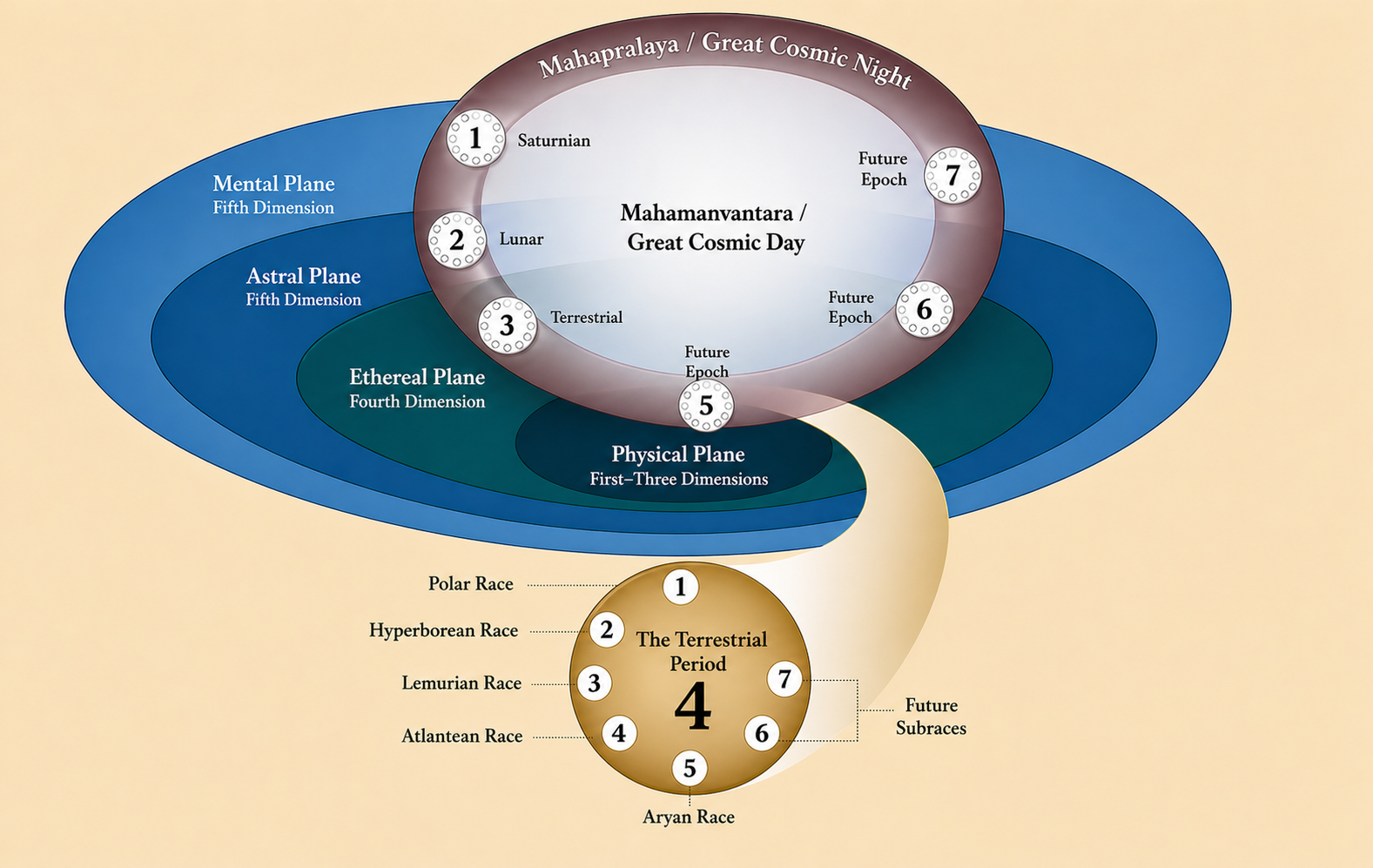
“Every Root Race has seven Subraces. The seed of our Aryan Root Race is Nordic, but when the Nordics mixed themselves with the Atlantean survivors, they gave origin onto the Subraces of the Aryan trunk.
First Subrace: It flourished in central Asia, in those now vanished kingdoms of central Asia, and whose ruins still exist in the Himalayas around the country of Tibet. Powerful spiritual civilizations of the first Aryan Subrace existed in those regions.
Second Subrace: It flourished in India and the entire south of Asia. In Pearland, the sacred land of the Vedas, in the ancient Hindustan, where the second Aryan Subrace developed, formidable esoteric cultures and tremendous civilizations existed.
Third Subrace: It created powerful civilizations. Babylon, Chaldea, Egypt, etc., etc. were the scenario of very rich and powerful civilizations created by the third Aryan Subrace.
Fourth Subrace: It developed in Rome, Greece, Italy, and Athens, the great city founded by the Goddess Athena. Before their degeneration and destruction, Greece and Italy were marvelous scenarios where the powerful civilizations of the fourth Aryan Subrace developed.
Fifth Subrace: Are the Anglo-Saxon and Teutonic. The First and Second World Wars, with all of their barbarism and moral corruption, point with their accusatory fingers to the men and women of the fifth Aryan Subrace.
Sixth Subrace: The mixture of the Spanish Conquistadors with the Native-American tribes. The effort to form the sixth Subrace in the redskin territory was very difficult, because the English Conquistadors destroyed them; they assassinated them, instead of mixing themselves with the natives. Only in a very insignificant and incipient way was the mixture of blood performed. This is why the Occult Fraternity saw the necessity of converting the North American territory into a melting crucible of races. So, the formation of the sixth Subrace in the United States had enormous difficulties; there, all the races of the world have mixed. The sixth Subrace in Latin America was formed very easily and this is something that must not be ignored by the treatisers of anthropogenesis and occultism.
Seventh Subrace: The survivors of the new great cataclysm that soon will destroy this Aryan Root Race will be formed by the survivors of the Seventh Subrace; they still do not exist, but they will. So, this Aryan Root Race, instead of evolving, has devolved, and its corruption is now worse than that of the Atlanteans in their epoch. Its wickedness is so great that it has reached unto heaven.”
Samael Aun Weor, The Kabbalah of the Mayan Mysteries
The first two [subraces had religions that didn't quite degenerate as much] (go fully from a pure stage all the way to atheism). The main religions from them, like Hinduism and Tibetan Buddhism—those religions didn’t quite degenerate as far as our later religions (from other subraces).
“Monotheism always leads to anthropomorphism, - idolatry -, originating, by reaction, atheist materialism; that is why we prefer polytheism.”
Samael Aun Weor
But what we could see in the Mesopotamian tradition is that it had already anthropomorphized gods, but it's still pretty close more to the original tradition that we would see, say, in the Vedas, and then over the time period of that subrace, it moved down towards, say, where it was in Greek times, and then eventually almost into monotheism.—Which in the Babylonian times, it didn't quite become monotheistic, but it was that which influenced the pharaoh in Egypt—Akhenaten— and that would eventually create a monotheistic religion as well as then which led to Judaism, and then Christianity.
Instructor:
Judeo-Christian religion.
Instructor:
So, this is a quick overview of the contents page covering what we will go through
The roots of the Western religious mythologies, pretty much across the board, both polytheistic and monotheistic, all trace back to this tradition, except for perhaps some newer religions.
These are the roots of the teachings of Moses and subsequent historically teachings from the following time periods. These roots are connected to all of the early teachings in Genesis, as well as the Greek, Egyptian and Norse mythologies.
Then we're going to look at the trinity of Mesopotamia. Every religion that at least has a valid link to the Universal Source tends to have an aspect of the Holy Trinity, even Islam, although it's hard to find in Islam.
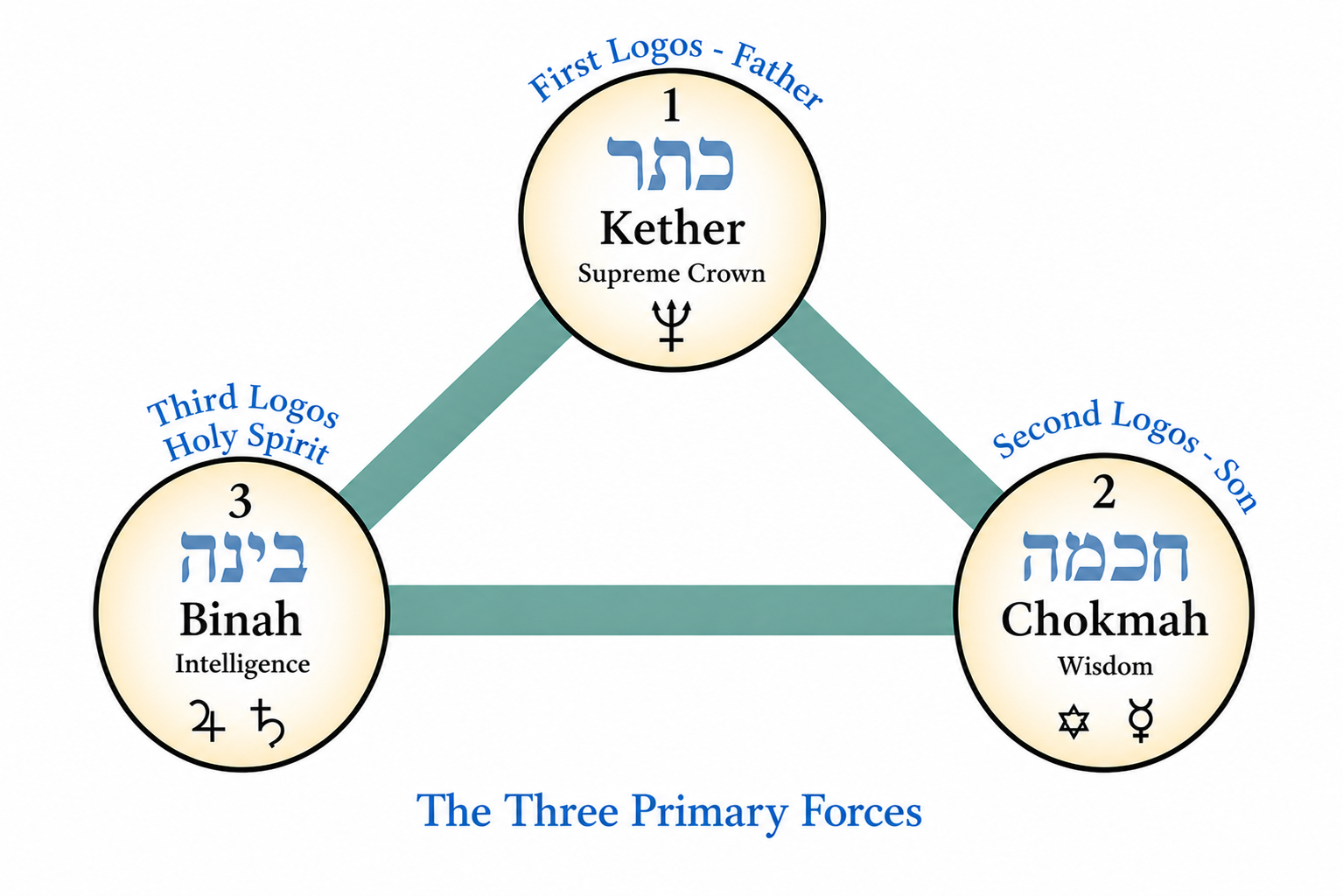
But the 3 forces are really one.
And then we will also look at Inanna specifically, which is the goddess of love, and divine feminine aspect, as well as her sister, or inverse aspect of Ereshkigal, who was the queen of the underworld.
Then we'll talk about Nammu or Tiamat, which is her more famous name—the Babylonian name—who is kind of the chaos cosmic primeval mother. And actually, in the earliest, symbolisms that we've seen in Sumerian mythology, was when Nammu was worshipped as part of more of a matriarchal religion. And then this also goes back to, say, Tibetan Guanyin (Tibetan: Chenrezig), that religions coming out of Atlantis were more matriarchal.
There's a reason for that. But the shift eventually to patriarchal society (and religions) happened during this time and is reflected in the mythology as well, that we can see. And we'll talk about that as well.
Then we'll look at Marduk, who is the Babylonian patron deity, who is analogous to Zeus, as ruler of Jupiter, and also this is the deity that we sort of see where the religion itself started to degenerate from a polytheistic towards a monotheistic view, which Master Samael actually said is a result of the natural degradation of spirituality.
He says, originally, you have the truth and a known religion with Unity Consciousness, or working towards that.
As that degenerates, we start to anthropomorphize the aspects of this multiple perfect unity. It becomes polytheism, and that then degenerates and people don't trust that. So then comes monotheism because it's a reaction to that. So, “Oh, not multiple gods!—One god!” And then eventually after that degenerates, you have atheism, which is what we see a lot during this time. Because you just don't trust religion at all. So that is the order of it.
You could actually sort of see that order. I mean, not all the way to atheism it was ancient times (more degeneration would come later), but you can see that order in the lineage of the mythology in ancient Mesopotamia.
Then last, we will talk about Anunaki and their relationship to the ancient alien theory, and the ancient astronaut theory, and then we'll have a summary.
All right, as we were saying, the, this region influenced all of the traditions that we see in our Western mythologies, and it starts from the beginning.
We could say that the original 7 Anunaki or the patron deities that include their Holy Trinity like Enki, Enlil, and Anu, and Inana, are more akin to what—when we look at Greece—would be the Titans and the Titanomachy, right?
Audience Member:
What areas does Sumeria cover? Is it like Iraq, Persia?
Instructor:
Yeah, it's Tigris and the Euphrates River
Audience Member:
Egypt?
Instructor:
No. Egypt is in Northern Africa. This is more in the Middle East. I believe it's Iraq and maybe Persia, a little bit, but definitely the main basin so like where Baghdad is. I mean around where Babylon was and that's where the Tigris and the Euphrates meet.
Audience Member:
Okay, right. I like to visualize.
Instructor:
My geography is not the best, but I do know that's a main theme that came up in a lot of their myths, which actually wasn't something I was going to necessarily talk about today because was it for the esoteric symbolology. But the way they express duality symbolically—a lot of the times—because of those 2 rivers that met and then create the estuary, was through talking about the twin rivers or freshwater and salt water.
So, the original Pantheon, would probably more relate to something along the lines of the the Titans in Greek mythology. When we look at the stories of how after political movements, certain gods would replace other gods, and this is a symbolically a reflection of the changing of the religion, of it degenerating.
But the Sumerian mythology was older than that (the Greek Pantheon). So, whereas there wasn't really a time in Greece where they truly worshiped the Titans—or maybe maybe really far back in the archaic period—because I believe there was a there was a temple we saw to Menelaus and Helen and just outside of Sparta.—And the Mycenaean period. But there's not much evidence of worship, at least to the Titans, outside of one Roman temple, which was an antiquity in Athens.
But the story from that, and the younger gods that overthrow their gods, comes from the story of the later myths, where Marduk—who would represent Zeus—overthrows these older Anunnaki gods, so in a sense, that story of the Titanomaki is about the change in the religion from this time period and probably then retranslated over into later times. But it stayed in the oral tradition.
We could say that the original Anunaki represent that original order of deities that perhaps came from the Atlantean times, and there were still a connection to that before the religions started changing.
And the interesting thing that we could look at with this is that the number is seven. And when we think about the organization of the reality, and we think about the descent of Spirit into matter. It's interesting to note that there are seven deities, and that’s before the aspects got split into 12, which we see in all the later traditions in Egypt and the Norse myths. There are 12 Olympians, and there are 12 tribes of Israel.
Seven relates to what we would call the superior realms, or what in Christianity, they call the heavens, or the realm of the, the angels or Devas, the Cosmocreators. And it's actually the level of reality that's above ours—those that create this reality. And that is organized by the number seven.
When we look at the reality from the top, the Unity is the three-in-one, three that's also one. But we could say that the organization starts with one, then three symbolically. There's not really a place where it's “organized by three” (because of the fact that the three ARE one), but it was one, then three. There's three aspects of that one.
And the first division is seven, and then from that come those creators that created man. The gods that created us, would then create inside of 12. So it's very interesting in that sense to look at the symbology of that number 7 and the fact that there were only 7 specifically when we look at the divine feminine.
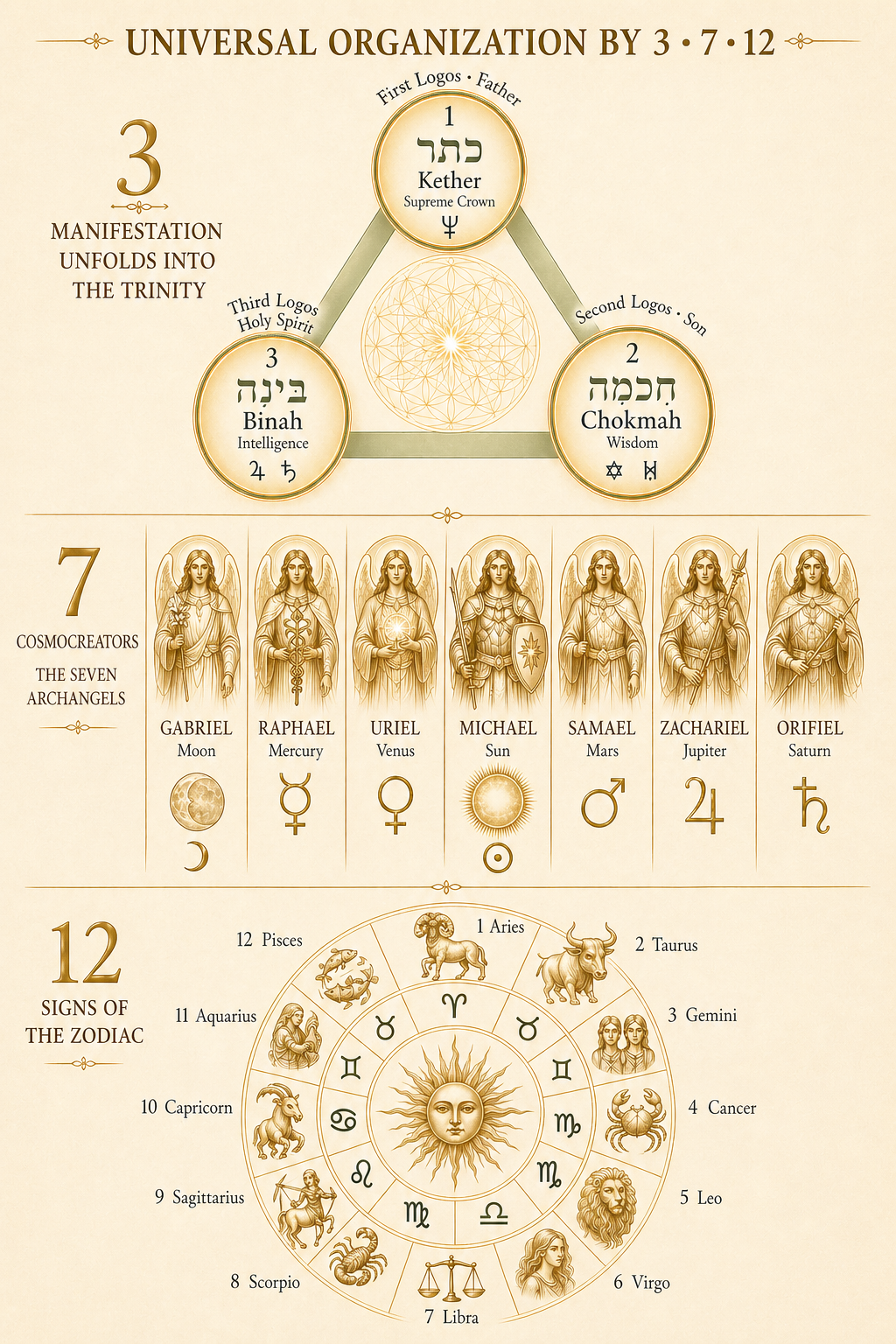
Organization by 1(3), 7, 12
So we'll talk about Innana later in the slide, but Inana, ruler of Venus—clearly related to Aphrodite—would later take that tradition. It's almost—if you're familiar with the Greek pantheon—the combination of all the Greek goddesses in one, which later gets split. It is the divine mother and the feminine aspect of the creative force, but still in a unity. Whereas if we look at the later mythologies, they took the different aspects of that feminine force and gave a different name to each of those principles.
Like, for example, Artemis is chastity; Athena is wisdom; Aphrodite is still just the raw, creative love-energy. But really, all of those are principles of the cosmic feminine. So that's one place where it doesn't really split off yet. But, in this sense, it's the original religion before it started to degradate down.
The other thing that we'll see is that later on, as I already said, when Marduk, the patron deity of Babylon—for political reasons—was pushed, they edited the narrative that he defeats Tiamat and takes over for the old reign of gods, which almost certainly influences the Titanomachy, as he is the ruler of Jupiter, which is analogous to Zeus or Baal or Thor, or all these other storm gods.
He's basically that storm god. We start to see not only the splitting down into 12, but eventually also, what we see is more favor and worship start going towards this god. The people of the time start to say that the other gods basically are aspects of him. So in that sense, it starts to be a push towards monotheism, not so much that they say there aren't other gods. But if we think of in, say, Genesis and Judaism, by that point, it's just that there's one god and all the angels are the aspects of him, which is a perspective to look at, in the sense of—there is one unity and the 7 aspects or the 12 aspects are all just vibrations within that one frequency.
Now, other things that we could look at which directly relate—we mentioned Genesis. Basically, Genesis—the myth of Eden, is directly within the Sumerian creation myth. So in the Sumerian version, Eden was not necessarily portrayed as a paradise, but rather as a place where work needed to happen. And the Annunaki were the Lord gods, the 7 above, and then there were underling gods (Igigi) underneath them, in a hierarchy.—That were supposed to do the work, and those gods didn't want to do the work. They were too lazy. So in that sense, they say that they created man then to do the work for them, out of the local fauna so that the gods no longer had to work.
Now, this, this is a very interesting thing to look at when we understand of how the 7 Cosmocreators or the archangels or these 7 Anunaki allegedly work. We think of these principles that create a reality, that organize our reality as hive beings. So when we look at the angels and they have a hierarchy—there are cherubim, seraphim, all of that—that is a reflection of that there are really just these seven divisions (in nature or manifestation) and within those divisions are other divisions, and they all answer to a larger whole.
And the Sumerian creation myth really shows that. It's also where the ancient alien theory comes from as well.
And if we were to look at it in one perspective, it's beings from the sky and they created man to work for them or mine for gold is what they like the alien theorists like to say. So that's directly in the scriptures. So, if you want to perceive it as “aliens created us to mine gold for them”, it's not incorrect. It's a way to look at it.
But, in a sense, it shows that the real symbolism and esoteric value is the descent of Spirit into matter. So the spirit descends from one, the first division is seven, and there are more divisions, and then eventually, those beings create the beings beneath them. So the higher selves then create the lower selves, and subjectively, we can look at it this way as well, they force us to work, but there is a work that needs to be done.
Like the higher self, or any of those beings are within the Construct that we are as well. So they're not yet fully awakened, but they also can't do the work that is required to awaken. So they're required to actually send down pieces of themselves through the soul to do the (spiritual awakening) work that we do here in the physical plane. It's actually necessary for the ascension back up.
So, subjective stories aside of these aliens that created us to do work and do all these jobs, what we're really seeing in that myth is the math and the dissension of the Spirit into matter and how the scenario was created.
Then other things that we look at is the connection to Biblical times. There's the story of the Tower of Babel.
Audience Member:
I might have made a mistake. Could you say more about the three goes next to Source?
Instructor:
Yes, so we are going to talk about that in the next slide.
So the way we look at at the Ray of Creation or the Reality itself, is there are three aspects to it. In Christianity, it’s the father, the son, and the Holy Spirit. In Sumerian, we have Anu, Enlil and Enki. But these three aspects represent, basically, a positive force, a negative force, and a source that binds, a force that binds them together, a conciliatory force.
We look at the atom. The atom has a proton, an electron, and then there are neutrons that give it mass and weight. These 3 subatomic particles represent those three forces in nature. So, we say three, but it's not really like that.
Seven is an organization of this reality. We have 7 chakras, right? There are 7 Cosmocreators. That is an actual organization of a part of the Maya and the illusion. The 3 is more just the 3 forces that the one uses to create, but there isn’t actually like a layer of the Reality where it’s only organized by three.
But it is the duality that the All creates through and the neutral balance actually represents being centered and connected to that Unity, and it creates through the duality so it can have an experience.
Audience Member:
Other words for that Gnosticism, for the for the sort of polarity and then the unifying center.
Instructor:
Well, we call the Third Force the Conciliatory Force. And like I said, the positive and the negative (together) would be the illusion or the duality, the Maya.
Instructor:
They can be called black and white. Because gnosis is a synthesis, so what they'll say is, it's called this and this and this and this and this in every tradition. So Father, Son, Holy Spirit. Brahma, Vishnu, Shiva.
Instructor:
Yes, Brahma, Vishnu, Shiva is a good one. Brahma would be the neutral force because it represents the actual Father. And then Vishnu would be the cosmic Christ or that order-organizing force that represents the summation of the Devas, and then Shiva, the creator-destroyer, the creative energy that we create and destroy through.
But all of that is all One. It's all together. It only separates at the point of manifestation. And then from that point of manifestation, we start organizing within 7 and then 12.
Actually, we will show the Tree of Life briefly. It's not going mean much to you, without more explanation, but the geometry of this shows where it is without me explaining too much.
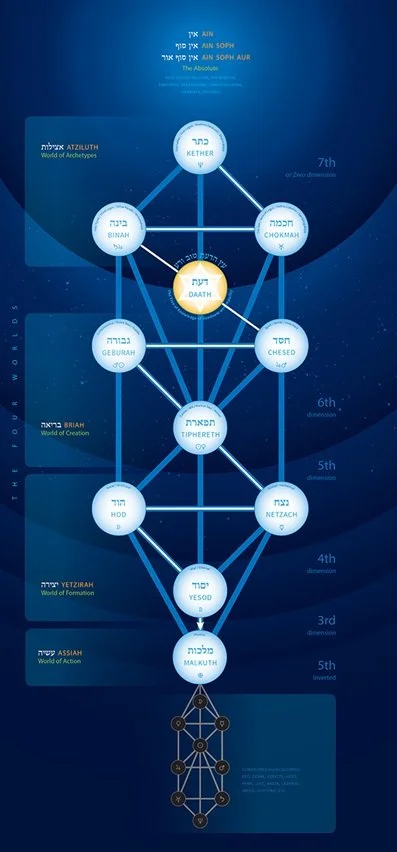
The Tree of Life
Up here is this. (Points to top of Tree of Life) These 3 aspects are one ray, and from this point, this would be what we say, is the point of manifestation or the Morning Star. (Da’ath)—Where reality from the unmanifested starts coming down here. Then in this trinity right here (Points to the Middle Triangle on the Tree of Life), we could say this is related to the organization of 7, and that those 7 beings are a summation of the feminine aspect.
So, one breaks into 7 and then breaks more and more.
And then down here, this is where we are. (Points to Malkuth) We're in the physical, and this trinity here is organized by 12, which is where we have like the 12 zodiac signs. So it's just more succinct vibrations.
Because there's one vibration that encompasses all. There's white light, right? White light—you shine it through a prism, now you get 7 lights. Those are your, let's say, your 7 Logos or the 7 Cosmocreators. But then within those those 7 colors, we also have various shades of color, and various different frequencies. So all of that lines up to where we are within it.
Everyone unfolds through one of those seven. We could say that how we all have a zodiac sign for our physical person, our higher self has come through one of those rays. So, to an extent, it affects our personalities a little bit, but that's just finding your way all the way back up to that one frequency that everyone comes from.
The tower of Babel—which we know from the Old Testament—is almost certainly linked to an actual historical event in Babylon. There was a zigurat that was actually pledged to Marduk—who we'll talk about later—and at some point it got destroyed. And, that zigurat is supposedly the inspiration for the mythology of the Tower of Babel. It's called Etemenanki.
But the thing that's really fascinating is that myth is such a blend between symbolism and historical events.
For example, there's a similar story of the Tower of Babel in Mexico, which clearly isn't about that Zigurat, but probably something else got destroyed, and they layered the symbology onto it as well.
But where it really gets fascinating is when we look back to the older traditions, which are a little bit more closer to the origination. And in Hinduism, there's a story about how everybody had got separated by their beliefs and their languages, similar to the Tower of Babel. However, it's not about a building. It's more of a symbolic thing.
There was a tree that grows too high, and the tree almost reaches God in the heavens, but the tree still “has pride”. So God (Brahma) shoots it back down, and it breaks apart into all the different fragmentations. Now, this is much more symbolic for what it actually is talking about. What happens with myth like this is that you already have these old traditions and the stories. Then a real event happens. Now we layer that onto the symbolism. So it's something that people can remember happening. And now we add the symbology of the esoterisism onto it.
When we really look at that myth, what is it really showing? And this goes into some cosmology. But basically, when Source creates, it doubles itself first. The Eternal creates out of what we could call the periodical Mahamavantaras, the Reality that we're in.
Now, “periodical” doesn't mean that the beings that are in that creation aren't eternal in a sense (meaning they are eternal), but they're within a spiral of being created. They're being born still, and they're evolving.
Now, we could say that that line that's related to the seven Cosmocreators—it's summation—is the Unity itself. But it's the Unity that's growing to be birthed into the other Unity. (The simple explanation of this is that the negative double is eternally growing into its own positive origination.)
Now, like we said, it's periodical; not the whole thing comes out every time. It has to go through multiple of forms of what we call Pralaya, which is when everything returns. And then there's another point of manifestation. But if we think about what that tree growing up that still has pride is, it's a being that perhaps is awakening consciousness or like the representation of that periodical being that has reached a certain height. But it still has pride.
You can't go back to the original unity until we disidentify from the false sense of self. So, to me, what it's a symbol of is, It's a symbol of the Pralaya itself. We talk about the hell realms and Avitcii and all these things. They are the symbol for when we can't disidentify from the lower person, and therefore nature removes the lower ego naturally. And then we learn from the experience, because you always learn from your experience. It's never bad.
Definitely that’s the thing that people don't understand, the meaning of eternal suffering. It’s just that eternity is the universe. So it just means we're in this stuck in the wheel (this Universe or Matrix) until we awaken out of it.
But to an extent, the higher ego—if you've got to the point where you're already getting away from the lower ego, but you haven't actually awakened from the higher ego—the higher ego also goes through a process where if you haven't detached from it, it gets removed as well. And that's basically Pralaya. Pralaya, to a higher being, is the same as us going to the hell realms, because we didn't awaken. So, to an extent, that's what it sounds like to me, and that myth is that the pride reaches up and then, oh, God (Brahma) shoots you back down; you break back apart and have to go back down and do the work again until you have no pride. And then that is how we get split and separated and stay in separation. And that separation is related to the false sense of self.
But the story of this and how we got all the languages then gets overlaid over something like the ziggurat in Babylon.
Like I said, there's a similar myth in Mexico, so somebody else had a similar idea. Maybe a building got destroyed there. That was really tall. Actually, the Aztecs have a similar myth. But this is how these myths get created.
And then one other one is the Epic of Gilgamesh, which is what people usually talk about when discussing Mesopotamian mythology, and I'm not going to actually talk about it too much.
There's basically the flood story. Almost every religion ever has had a flood story. And this one is clearly the one that influenced Noah's ark. In the Sumerian myth, Enlil thinks that humans are too loud. He's really petty and just wants to destroy them. So, he comes down and tells his favorite human to build a boat. It's very similar to like the Biblical myth, just a little bit funnier.
Instructor:
Because we're loud.
Instructor:
And then after when he spares them, he convinces his brother that, “Oh, the humans aren't so bad.” And then he feels bad about it, supposedly.
There's some other things in the Epic of Gilgamesh. The thing with Gilgamesh, that's really interesting is that it's symbolically, esoterically, a symbol of somebody who doesn't take to the path of esotericism and doesn't take to the mysteries.
So he goes on the Hero's Journey, and he is a hero, and he loses his partner, Enkidu, who represents his wild side. And the whole time he's looking for immortality, and he meets a guy who's immortal, and he tells them, “Oh, you have to let go of things. It was a one time deal (meaning that the other immortal guy became immortal with a way that only worked for him), but I'll send you to this plant that will give you eternal youth and restore your youth.”
And he gets the plant and he leaves it on the side while he's bathing in the waters. And a snake eats it.
For example, the snake represents using the creative energy.
And in the myth also, Innana, the goddess of love, wants to marry him and he (Gilgamesh) rebukes her. She represents the creative energy. So it's this idea that the pathway to the eternal life, to immortality is to work with the creative energy. And when we're ignorant of it, we don't get it.
So at the end of the whole epic, he reserves himself, basically, to just saying, “Well, you can't become immortal.” Because, I guess he never figured out that you have to work with the creative energy, and he never wanted to work with saving the creative energy. He then comes to the terms with that, “Well, what we do in our life is what matters and the works that we do,” and that is a symbol of that before we go toward ascension, all the things we build and learn over one lifetime are what are really important because they transfer on over to the next and the next...
But he's actually the sign of somebody who doesn't get into esotericism, which is pretty funny. There are some references there.
And then one more thing.
Two, when Moses parts the Red Sea is another good example of an older myth being overlaid on something that may have been a historical event. People say the Red Sea may have receded when the volcano in Santorini went off. So there might have been an actual time where the water was pulled back, and then a tidal wave came back over.
Now, the idea of the splitting of the rivers comes from the Babylonian creation myth between Marduk and Tiamat, where he splits Tiamat—she is the chaos of the waters—to create the world in between. So he splits the duality through his control over the balance to create the world, which is very similar to what happens in the story. And Moses has similar symbology.
Moses, who is a solar man, splits the Red Sea, and he takes the Israelites (who represent the awakened) through, and then when the Egyptians come (who are those who are not initiated, and they represent the ego); it washes them back out. This represents that to ascend we must maintain the balance between the positive and negative.
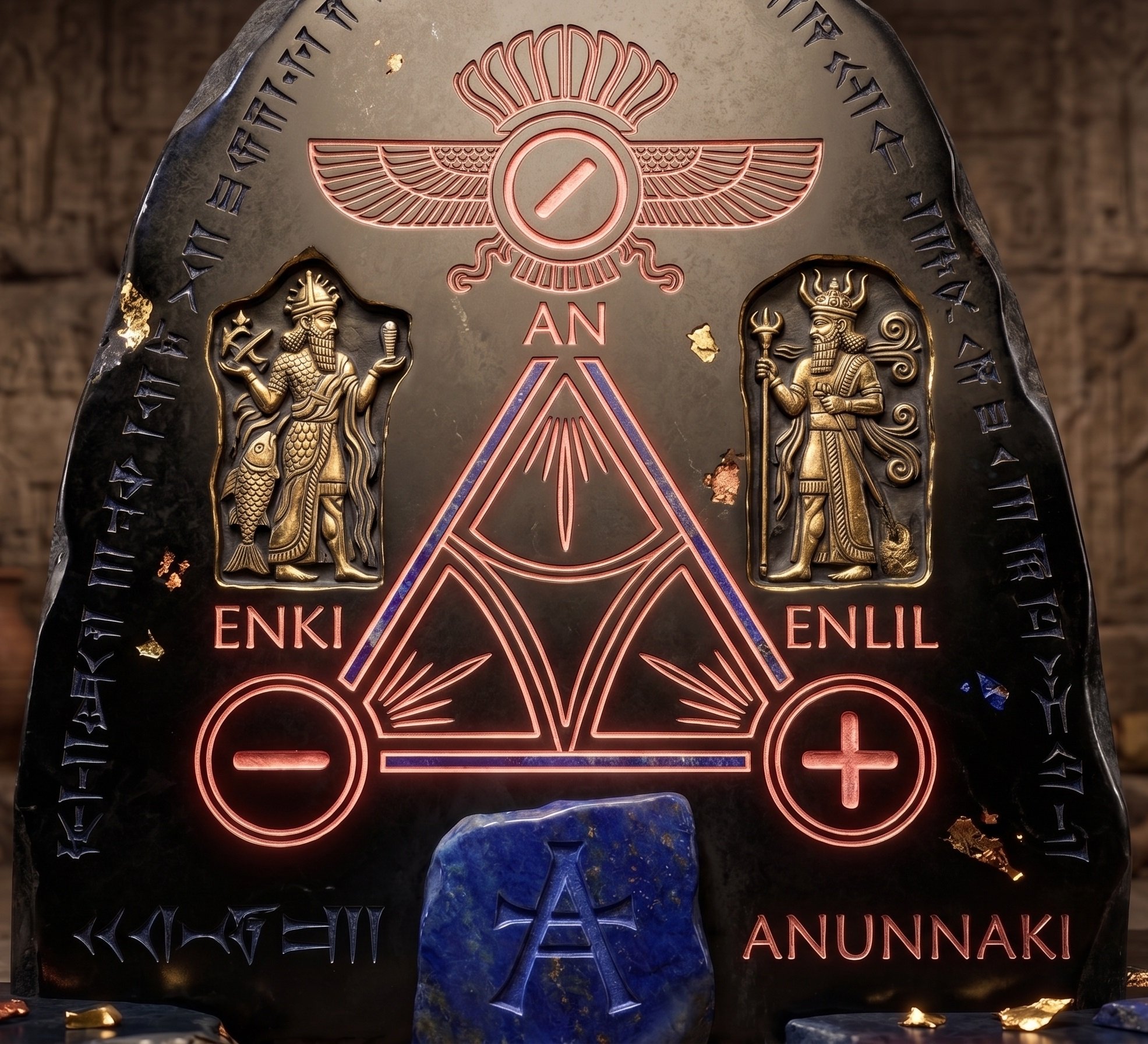
So, we were talking about the three forces. And here are is the three forces as they come through in the original trinity, at least in the Sumerian myths, as well as two of them have name changes in Babylon. But there's An, Enlil, and Enki.
An literally means heaven. So we take the sky god or Oranos. We could look at that and if we're looking at it as the Titans. The original—it was, it was Oranos, Earth and Gaia.
So, An would be that character, just literally the sky, the heavens. He represents the unmanifested unity and pure creative energy of the divine outside of the manifestation.
And then you have the sons, Enlil and Enki. Now, Enlil, for sure, is related to Yahweh in the Old Testament. We could also relate him to Saturn or Kronos. And in that sense, Saturn or Satan or Satan, right?—Shows his relationship with the material and that aspect of reality.
Later on in Christianity, Lucifer became just this evil devil character, but actually that connection to the material and to time shows an important aspect of what the illusion is, and it's that that creates the reality ourselves. So if we think of Cronus or Saturn, he was also the god of time, as well as material.
Now, in the Greek myth, it actually became it a little bit more esoteric in the sense that Cronus castrates Oranos. And when Oranos’ genitals fall into the water, it births Aphrodite, who is the, embodiment of the creative energy in the Greek myth.
And this symbolises how—I believe—Enki just poisoned him (An, the Father) or something like that, in the Sumerian myth. But, again, this is the shades of the Titanomachy. And when Enki does kill An, he takes possession of the creative waters. And Enki is the water god. So we could relate him to Poseidon, or he is also related to Osiris in Egyptian mythology.
And Enki truly is the friend of man, we could say. And when we look at Enki, he also could be represented as the serpent in the garden, to which Christians would say, “Oh no, that makes him the Devil. That a bad thing!” But that's not actually the case if we really think about what's going on with that story, what is really happening
In the original Sumerian creation myth, Enlil is just using the humans as slaves, and it's actually Enki, who feels bad for man's predicament. And he brings them—the alien people say, through a genetic mutation—but brings them the ability to then to thus become like the gods. And he gives them some type of knowledge. And in the Bible, that that's what the Tree of Knowledge represents.
If we think about what Yahweh says about why he has to expel Adam and Eve out of the garden, it is because he says, “We can't let them eat from the Tree of Knowledge. Because once they eat from the Tree of Knowledge, they will be able to eat from the Tree of Life.” And symbolically this means they can surpass the gods, because the gods themselves can't get out of the system.
So the Elohim in the Bible want to hold man down because they can't actually themselves yet rise. So Enki, in that sense, or the serpent in the garden—the symbol for the Kundalini and the creative energy—the serpent gets us to eat from the Tree of Knowledge or the Tree of Good and Bad, so that we can perceive the duality. And yes, that means we get cast out. Yes, that means we fall asleep, but also it means we now have the ability to awaken the consciousness. That's what that's a symbol for.
And in the Sumerian myth, in the original Edenic myth, this was well known. So Enki was seen as the friend of man where Enlil didn't want the people to be able to have this ability. It later gets changed and inverted, and there's a reason behind that. Because the Judeo-Christian religions seem to sometimes have an inverted spin, just from, changes of understanding that we'll get into later.
But in originality, that Lucifer character was bringing us the knowledge. Because Lucifer is both the devil—as in our shadow, but in the positive aspect is the morning star or that point of manifestation. So, it gives us the opportunity to climb the ladder, or the stairway to heaven, the vertical line on the Christian cross.
So Enki was very important in all of these traditions, because until later when he was called Ea, and Marduk usurps the power of the creative waters from him, he was basically the deity that both represented the energy itself and the creative energy in the waters, but also the duality that we have to work with; and understanding and being balanced between that duality and working with both sides. He was thought of as clever and wisdom, and all of these things that come along with that balance.
He was said to also control this region beneath the earth called the Apsu, which was these underwater waters, which is a symbol for in ourselves the sacral chakra in the area where the sexual energy is, and the ability to manifest and use those waters to awaken. And that was Enki's position.
And we can even look at Enki and Enlil and see that little rivalry goes on through many mythologies. We could say that they're Set and Osiris. And if we follow the Sumerian tradition, Enki—when he flees Enlil—goes to Egypt. And perhaps the continuation of those mythologies and those stories that are later with Set and Osiris are related to that.
I know there are even some links to Aztec and Quetzalcoatl, but we won’t get that far off topic.
But also, the original Atlantean myth that, in Greece has Zeus and Poseidon. And Poseidon is the one protecting… He is the water god protecting Atlantis. And Zeus is portrayed as this evil dad-god, which is not really normal for Zeus's role. Zeus is usually in a different role. But in that role, it's almost like, the Titans and that tradition harkens back to an older time before the Greek mythology. So they may have just put names to make it fit.
But in that situation with the context—Atlantis obviously happened way before Greece.—and this is a told-down story, that the Zeus character is playing the character of Enlil. And Poseidon was the water god with the trident, which also Enki had the trident. The trident was a symbol of the creative waters in Sumerian mythology. So, in that sense too.
Instructor:
So, who's who in the plus-minus-neutral?
Instructor:
So, the neutral would be An, the Brahma character or that aspect of the heavens, and then Enlil would be the plus. And Enki would be the minus. So Enki would be the feminine principle representing the waters, and then Enlil would represent the masculine. (Order)
Audience Member:
I wonder for the Greek analog, for An or Anu? I mean, Hades was kind of neutral or it would be like Hestia or something.
Instructor:
Oh, Hades would be like Ereshkigal or the king of the underworld or Pluto would be a different aspect, but the aspect related to our Klipoths (our own internal hell, our shadow). Actually maybe Hades would be closer to Enlil, as in Saturn (in the inverse). He would be representing the ray of death.
But An would be Oranos. Literally, it's almost analogous, exactly the same.
Because the original sky god, like I said, that the original Anunnaki gods would probably more be analogous to the Titans. But then, things get shifted around because traditions are passed down. But the original story of the Titans overthrowing Oranos—and then the Titans get overthrown by Zeus and the Olympians—Zeus and the Olympians would be representative of Enki’s son, Marduk.
This is Inana, and we're going to spend some time on this. So, Inana or Ishtar, as she was known later in Babylonian times, was the goddess of love and the ruler of Venus. Her symbol was an 8 pointed star. Which esoterically points to…
When we look at the goddess of love, and this is whether we're looking at Aphrodite, or we're looking at Ishtar or Freya, we think of it in terms of this organization of seven and those seven rays, but there's an important aspect that comes about love itself, and there are a lot of clues that we have, when we look at the standing of this ray or to the others (when we look at the different types of rays).
In the Secret Doctrine, Helena Blavatsky talks about how there is one ray that begets 6 more, and that's where we get our 7, which means that one of the 7 rays is actually the recapitulation down of the original Ray of Creation before it splits off the other 6.
Now, when we look at Theosophy—I don't think they actually assign planets to them, and they're not necessarily one to one with the rays in Gnosis, but there's one consistent—and also New Age has it as well—but there's one consistency between all of the different forms (Theosophy, Gnosis & New Age). You know, you can say whatever you want for the other 6 rays. There's always one Ray of Love.
The other 6 rays are related to aspects of love, in the sense of something like devotion or chastity or all these type of things, right? So they're all related to another aspect of love. So in that sense, love—in our (human)perspective—unconditional love, is the aspect in our reality that through which we connect to the higher level of the life force itself or the creative energy. It is that. That’s how we perceive it.
That's why all the traditions, whether it's Buddhism, we're looking to do Metta (Pali - the Buddhist practice of cultivating unconditional, boundless loving-kindness toward all beings), we're doing all these things. We're looking for this feeling of love and not love as an attachment, but love as in, it is the energy at a higher point, right?
If you were to go beyond and into a Samadhi, and you go beyond the illusion, and you still connect to that energy beyond where we have a concept of love. It's that energy. It's that force. But we perceive it in our reality as love. In that sense, It points to the fact that the aspect of the ancient traditions that relates to love is actually speaking about that higher force or that life force or the Fohat itself.
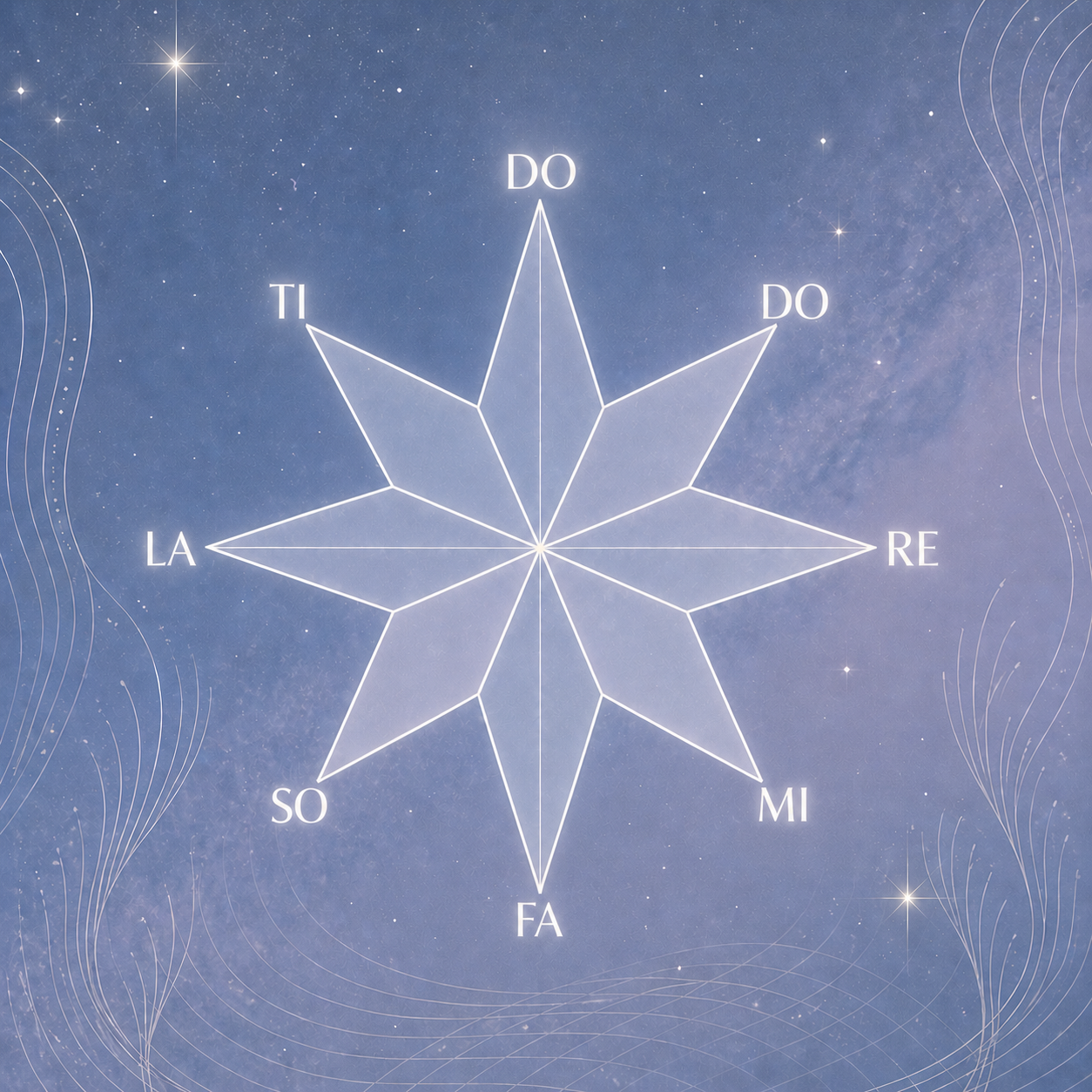
8-pointed star shows ascension through raising an octave
And there's a lot of clues to this. First we’ll start with Innana and then I'll point to some other things with Aphrodite. But first of all, the 8-pointed star in itself, right? With he 8 pointed star, there are 7 aspects, which means the aspect of awakening from the earth to the sun. If we were look at it as a musical scale—because we can overlay an octave over any journey—the 8th note represents the same as a first, but at a higher octave. So, that already, that is a clue as to what this represents.
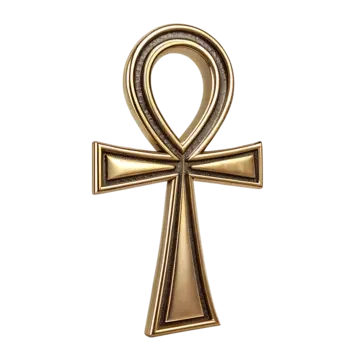
But then also, when we look at the planetary ruler of Venus, and we look at the symbol of Venus—that symbol of Venus, which we could also say is the ankh, the Egyptian ankh. We have an ankh here on the table. This symbol was used in ancient Egypt, but esoterically, what the symbol represents is man ascended. We have the cross. The cross represents the level of being and the horizontal line that we live in. And then the circle being on top means the spirit is ascended.
Now, we're not talking about a planet here. We're saying this principle (the Ray of Creation) represents that (man ascended). The planetary ray is related to those 7 rays that we talk about. And this ray comes down through it. But the actual symbol (of Venus) represents something higher (manifestation from outside of creation before the Ray of Creation splits).
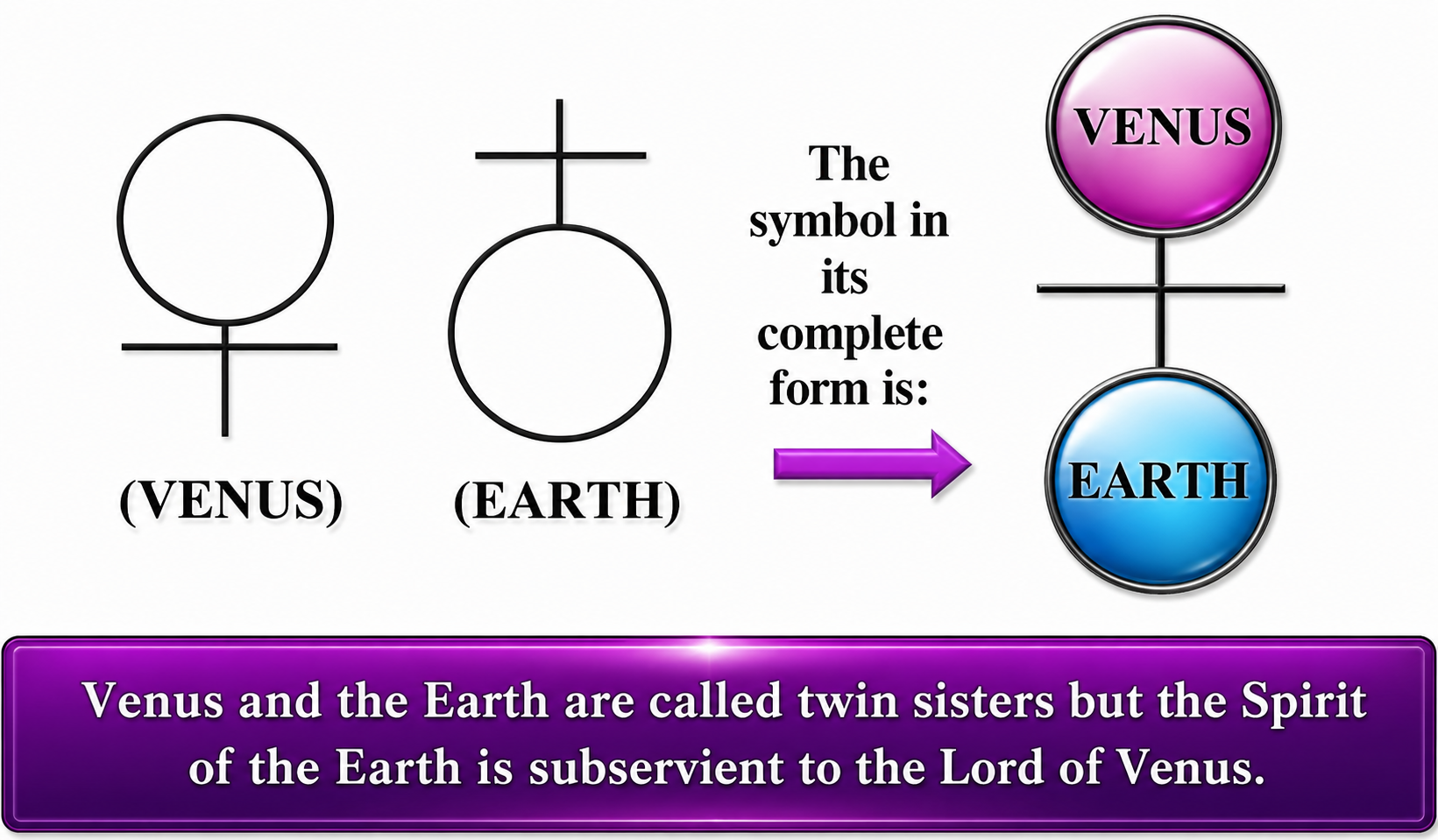
And then another interesting thing—and this is also from Theosophy, but the planetary symbol of Earth is that (points to symbol of Earth). So when you come down the middle and you come down the middle from the manifestation—(shows the two symbols) Venus ascended, Venus descended—that's the Ray of Creation and what we work with.
Also, the heart—whether we look at our heart chakra or the sun in the solar system as the heart of the solar system, the heart is related to a sephirah on that Tree of Life called Tiphereth. And that's also related to where the human soul is.—Manas, and the balance of the middle. It is also ruled by Venus, or Venus and the sun.
The sun in itself, we could say, is an interesting symbol as well. The sun can be related to the masculine aspect of this force (the Fohat or Life Force) in an ascended state, as in, the actual octave above us (Earth). But then there's also a planetary ray of the sun, which can confuse people, because of the fact that when they assigned the planetary rays, at that time, they weren't aware of Uranus and Neptune. So the classical 7 planets (in ancient astrology) include the sun and the moon as planets, but actually, if you go back to the older traditions (Esoteric), the seers were aware of Neptune and Uranus.
And also, the sun and the moon are not planetary chains, actually. The moon is the parent of this planetary chain, and the sun, as we said, represents the octave.

But it can get confusing because sometimes when they're talking about the sun (in esotericism), they're talking about the “little ray”, which is more likely related to Uranus. And, not the top one (the Ray of Creation). But the logo for the sun is actually this (draws symbol of the sun), which is a symbol of the I AM. So it still falls along with that.
Instructor:
It almost looks like, if you were looking down from here (points to arial view of the Venus symbol), but except it doesn't have the cross.
Instructor:
Yes, but that's what this one is. And the interesting thing, too, is to look at this in Greek, where you could tell they knew about this in the Greek traditions, and this can be seen when we look at Apollo and Artemis.
So, the Greek traditions at some point must have degenerated a little bit, and then in the Classical Period—whatever is going on in Eleusis—something else came out because they went from worshiping Zeus and Poseidon and all of that to where all their temples started being to Apollo and Aphrodite.
And the thing is that with Apollo—we associated it with the sun after it degenerated. We associated Apollo and Artemis with the sun and the moon, but Apollo is not the sun god and Artemis is not the moon god. Apollo pulls the sun, Artemis pulls the moon, as in the masculine force, the feminine force. Artemis is the goddess of chastity, which is related to this, (points to Tiphereth on the tree of life) the soul, Tiphereth, and Apollo is basically the Christ or that higher aspect like Enlil. And, in that sense, he's the god of harmony in music, which are qualities of the Ray of Love, creativeness, art all go along with the Ray of Love, because it's creativity. It is the creative energy. So, in that sense, we have that.
Also, Aphrodite in the Greek myths, they give sometimes a little secondary name to the beings. And we have Aphrodite-Orania, which represents the creative energy ascended, and then Aphrodite-Pandemos, which represents—she was the goddess of prostitutes instead of the ascended woman. And that represents lust and the energy descended. So that's one way to look at it.
But back, also to Innana.
Another thing is, like we said before, they split all the aspects of the divine mother into different things. She's (Innana) basically all of them in one. She's the goddess of the hunt, like Artemis. She's a goddess of chastity. She's a goddess of war, like Athena. She's obviously Venus because she's the ruler of Venus. But another clue that ties in with this is that An said his heir apparent was his daughter (Innana), so that Trinity that we looked at before goes from being An, Enlil, & Enki to Innana (she becomes the Conciliatory Force, one level down, in creation).
Audience Member:
That's his daughter.
Instructor:
Well, he fathered all of them. But they basically said that she inherits his power, right? Until Enki takes it later. But she's literally said to be the inheritance of the An. That's why she's Innana.—Which directly speaks to the fact that this creative force shoots that ray down. It's the literal embodiment of that ray that comes down into the manifestation.
Now, the main myth that that really deals with Innana, though—and esoterism—that's really interesting is…
Is anyone familiar with the descent of Innana into the underworld?
Audience Member:
I think where she takes off her adornments?
Instructor:
Yes, actually. I'll bring up Ereshkigal, who is her sister, who was the queen of the underworld, similar to Hela, in Norse mythology, and some other connections like that. But that inverse of the feminine—Persephone in Greek mythology—comes directly from this and we'll show it's tied together. But Persephone would be Ereshkigal. She was the queen of the underworld that represents that negative inverse of the of the divine mother. We could say like Kali.
But anyway, Ereshkigal’s domain was the underworld, and Innana—who was queen of everything—decided that she was going to go conquer the underworld. And the symbolism on this is really interesting because we're not talking about how in the Greek myth, by the time it gets to Eleusis, when we talk about Persephone going down, it's more of a symbol of the Essence and how the Essence got lost, as in Demeter is the Cosmic Mother and it's her daughter that goes down. She's the Essence that gets lost. But in these myths, there's a little bit more separation.
By the time of Greece and Egypt, the initiatic schools had started changing and the narrative shifted a little bit to where things are a little bit more neat. But in this older myth it’s literally that the principles themselves go down. So you have a story of how the creative energy (Spirit) is going to descend down into the Maya, and the original myth, at least, was to conquer it. She was going to go down there to conquer the underworld.
There's some later translation that says she went down for a wedding or all these other things. But she decides to descend down into the underworld. This is literally the Spirit descending into matter. She tells her minister, Nincubura, to go tell Enlil, go tell Enki, go tell An, that, she's going to go down and something's going to happen and that they need to help her because she's going to go missing. It's like, she already knows what's going to happen, right? And, that happens.
I think it's Enki who is the only one that actually decides to help her. Everyone else says, “Oh, she should know better. You shouldn't go down. The underworld, not for the gods,” right? But she starts, she goes. She starts this descent, right? And the symbology is pretty cool.
First, she has to go through the 7 gates of the underworld. Of course, there's 7, which represent our 7 bodies, or also those 7 principles, how things are organized at 7. And at each gate, like you said, she has to shed something that she's wearing until at the very end she ends up being naked. But it's symbolic of shedding the (Divine) ego and all of the material that we have to go through, and we have to go through these trials, and at each gate, we face a trial where we have to lose a little bit more of our (true) selves. There's an initiatic philosophy.
We talk about guardians of the threshold in ancient Gnosticism. In Gnosis, we talk about the 3 guardians that block our actual physical bodies’ brain centers. We say we have 3 brains. But in the ancient Gnostic tradition, they actually talked about Guardians at each of the 7 bodies. Jesus, I think, in the book of Mary Magdalene, talks about the 7 guardians, one for each sphere. And he says regarding I think the 4th one, the one that's related to the soul—if you conquer that one, then you conquer all of them, which is true.
Because if you access the causal body, if you incarnate Manas, the other tests after are more like a formality because basically if you can disidentify from your person, which is what it takes to access the Causal plane, so you've already disidentified, then even though those egos are related to higher spheres, you disidentify. You have to disidentify from the whole person to take that trial. And that's actually in the book of Mary, but he does mention that there's a guardian for each of these things. (Symbolically)
And in this myth of the descent, we're looking at it in the same way. It represents our 7 bodies, and we have to clear all 7 of those bodies.
Another myth that also looks at that? Osiris and Set, which we already said. Osiris is probably Enki. But Set chops up Osiris into 49 pieces, which is 7 pieces for each of the 7 bodies. Because we could say there's 7 sublayers to each one of those planes and our subconscious is made up of those 49 layers. So that's even more, but just the little intricate things that we have to break off.
But she goes down, and she reaches the bottom, and then immediately, Ereshkigal, her sister, kills her. She's dead; she's a corpse. And even this is symbolic of, when the spirit descends all the way down to the physical plane, there, we forget. And we basically become the Walking Dead for a certain amount of time.
Instructor:
Like zombies.
Instructor:
Yeah, we get lost. We don't just go down and then come right back up. We stay down here in the physical for, how long?
Instructor:
A long, long time.
Audience Member:
You said, the seven things that she sheds would be like the ego, but why if she's going down into physical reality?—You know what I mean?
Instructor:
Well, I mean more in the sense of, she's trying to conquer the underworld, so she's shedding all her things (forgetting her divinity) to have the right to take over the underworld, because we're coming down here to conquer the underworld.
Audience Member:
Okay.
Instructor:
So, she's shedding these things at each of these guardians, and then she gets down here. But then, just being rewarded immediately; then she's killed, then she comes that danger of unconsciousness, when she descends down into the physical.
Because if you think about when—in anthropology—with the root races before us that were coming down, they were all much more spiritual than us still. They didn't quite lose themselves until they got all the way to the bottom. They were on the descent.
Instructor:
For the ascent you would do the reverse.
Instructor:
Yes.
Instructor:
So that's when we came down. But for us wanting to ascend, then we would do the opposite of that?
Instructor:
No, the ascension part, and I was going to get to that.
So she died. So then Enki is the only one with the heart, right? Like we said, all the other gods didn’t want to help. Which is funny because we we talk about that Luciferic aspect, and it's actually—we think of Lucifer or Dionysus in the Eleusinian mysteries as a helper of the of the Divine Mother. That's literally in the Eleusinian mystery. Demeter is the Divine Mother, and through working with Demeter, and her helper, Dionysus, who Bacchus—who is also Lucifer, before he was a devil character—through that work, then we free Persephone, the Essence, right?
So, Enki you know, playing that role, he creates these 2 beings—a couple—and sends sends them to, amuse Ereshkigal. And basically through some negotiating, they say, “Oh, well, we'll do these things for you, because you like us, but only if you release the corpse of our queen.” And that in itself is a symbolism of the work of the (sexual) alchemy, of the two and to work with the alchemy and to bring the energy back up.
So, we see that that's what eventually restores Innana, and then she's able to come back up.
And then the last part of this myth is they say, though, “You can come back up, but you can't come back up without leaving something.” So somebody has to go as your replacement. And this is the example of how the false self has to die.
“All right? You work with the energy, you're going to come back up, you're going to ascend back up? Okay, the false sense of self has to die.”
So she has to send a replacement. So she goes back and the last symbol in this was pretty funny, but she goes back up to the heavens and she had sent her minister around to, tell everybody what was going to happen. And she went to this one God, and they they were in mourning because they knew she was going to die, and this one was mourning and mourning. And then she gets back to her husband. His name is Dumuzid, and basically, he's living it up, still being a king like.
Instructor:
Well he was partying that she was gone and dead. So he said, “Woo! She’s dead!”
Instructor:
Yeah. So, basically out of the anger of that, she chooses her him to be her replacement, and even that in itself is a symbolism, too. So, not only do we have to leave something behind to go back up, but we think about the commandment, to not covet someone else's wife, but really esoterically, it's to not commit adultery esoterically. Because adultery in an esoteric sense is to forget about the Divine Mother and the creative energy, not necessarily about your spouse. Although, if you were to do that (be unfaithful) out of lust, that's forgetting about the Divine Mother (too). So, it still works, and that doesn't mean that adultery is okay. But that, it's an ethical thing to not forget about our creative energy and how we work with the creative energy.
And in a sense, right? Well, all of the beings that mourn in Inna, they mourn the loss of the energy. They're not trying to lose the energy. And yet, the guy who says, “Yeah, this is great!” He forgot about his divine mother. Therefore, they punished him with unconsciousness.
Instructor:
So the more we waste our energy on the ego, then the more unconscious you will become.
Instructor:
Exactly.
Okay. So next, we're gonna talk about Tiamat. The original name was Nammu. But we're going to talk about her as Tiamat in the sense of the most important story and myth that we're going to go over is the one that relates to the Babylonian creation myth; at that point she's called Tiamat. But we will talk a little bit to the fact that as Namu, she is representing the other end of the waters.
So remember, we told you that their duality (Mesopotamians), they looked at it as the heaven and earth, but also as, fresh and salt water, because of the mixing of those rivers, so this was symbolic of the duality. The feminine was the salt water. So she represented the salt waters and the chaos—chaotic salt waters, I would say maybe like the Mulaprakriti, if you're familiar with, Hindu terminologies, but like the cosmic ether and matter.
So originally that what Tiamat was, just a cosmic principle, something abstract.—And I mean, when she was Nammu. And then eventually she becomes…
She was what was worshiped at the beginning, at the very, very beginning of these times, even before we started talking about these other aspects, when you just had Anu and Namu. And to that extent, we see that the post-diluvian civilizations still held on to this matriarchal-led spirituality. You often see that with Guanyin and the ancient Chinese texts and things like that.
And there was a reason for this. It is because the majority of the population is mechanical and asleep. The ego consciousness is very mechanical and subject to the energies that go on, on this planet—the planet Earth—all the way until the root race of Atlantis was in the descent. So it (the planet) was coming down into matter, just like how we were taking a descent down into matter. So that was reflected in the spirituality of planet.
People were meant to be moving more and more towards the physical. The earlier root races were spiritual, and they were moving more and more towards becoming physical. This is even symbolic in the sense that we talk about gods and then they created humans—as we think of as humans, but the earlier root races were the gods. We could say, they were 4th or 5th dimensional beings. They were creating humans in the sense of to create a vessel for them to be able to to incarnate a lower self into to do the work to come back up. Which is why it's not necessarily so nefarious (higher beings creating “us” to do the work). Symbols in the (Mesopotamian) scripture can make it sound nefarious, but it's a natural process.
Instructor:
Because “you” are “them”.
Instructor:
Yes.—Because we are all one. But this would have been reflected in the in society, not just religions, but society as well. It's known that most seers have seen in Atlantis that there were feminine-led societies, feminine-led religions. And this was an unconscious reflection because people don't even know necessarily why they're doing things out of this drive to move towards the feminine.
And then, now during this root race, as we're moving back up, the energy's shifting towards ascending.
And if we look at the span of this whole root race, pretty much by the Iron Age, so for the Kali Yuga, very early on, it shifted into this society becoming patriarchal in all senses, whether it's the workplace, whether it's spirituality, whether it's politics. And that's because at this point in time, during Kali Yuga, the population's the most unconscious that it has been during this root race. So now they're literally incapable of really understanding the means (the energies driving them) behind it.
We could look at things even—I think we talked about AI on Discord, and how AI is an unconscious feeling of the Age of Aquarius, where we were supposed to move back towards our divinity and our ability to be creators. But in the unconscious masses that aren't going to do the work, who are not going to awaken like that, they still feel the energies of wanting to create. They still feel the energies of wanting to be in spirituality.
There was a teacher, a philosopher that we know, and he made a good point. He said that never have there been more people on this planet at this current time that are in spirituality during this this root race. At the same time, we have the least amount of conscious people, so there's more people of spirituality than ever with this mystical pride, because they have the FOMO, like they could feel this energy.
Everybody wants to be woke. Everybody wants to awaken. But actually, it's harder to awaken now than it ever has been, and the actual people that actually are willing to face their ego and willing to do the work is the least that it has ever been. So, these are all things that massively affect… For example, we just had the Uranus transit, right? Expect that split to go even more. And, expect AI and things like that to blow up even more.
So these astrological energies don't have to affect us. If we're aware, we can either work with them or choose to not let them affect us, if we're awakened to a certain point. But when we are asleep, we basically are robots and we follow these things. Master Samiel said, for example, that every time there's been a world war, some planet squared or something like that, because the masses, they are…
Instructor:
They just follow the energy.
Instructor:
They follow that fate, like fate versus free will. Well, free will is if you're awakened in the level of the construct that you're in, then you have the free will to choose. But before that—if you're sleeping—then you are kind of a slave to the fate of those energies that are around you. You don't have to be. That's why there is free will, but to connect to the free will, we have to actually be aware that we even have a choice. Otherwise we're making the choices without even thinking about them.
Instructor:
Well, they'll say, “What do you mean? I want to do this!”
“Why do you want that? “
Instructor:
I've had that conversation before.
Audience Member:
“This is my choice, actually. I chose this.” That's so true.
Instructor:
Yes.
As we move forward with Tiamat, the one last thing we'll say about it, is that eventually later on, she came to be described as a dragon, first like a reptilian lady, which led to the Ancient Alien Theory. People love that. You know, and the Reptilian overlords. And then also eventually a dragon with multiple heads, which probably influenced one of the Twelve Labors of Hercules, when we look at how Marduk fought Tiamat, the multiple heads in the Hydra.
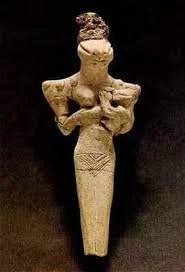
Nammu (Tiamat)
Audience Member:
So that second photograph, I mean, the statue that shows dug up somewhere. What is that like a… It almost looks like a serpent head?
Instructor:
Yes, she started off as an abstract concept similar to Anu, but later on, she was depicted as a dragon, and then eventually even a dragon with multiple heads, which is why we have a picture of the hydra over there.
Audience Member:
Is she holding a baby or something?
Instructor:
Yes, I think she is. She's nursing; looks like she's nursing. Tiamat represented that cosmic feminine principle, so like the Cosmic Mother, and was worshiped as that, as the first goddess of the tradition that they had.
Instructor:
Also, dragons and serpents have a big association with the creative energy because of the Kundalini.
Instructor:
And now that brings us to Marduk, who is the son of Enki, or Ea, is what Enki's name would have been in Babylonian times. Now, shows a trend and how shifting policies worked, and people would move their gods around to be more powerful. But the stories still sort of semi-hold true, but there are always some younger gods that beat off the older gods, etc., etc. And this is what happened with Marduk.
Marduk was originally the principal deity of Babylon, when Babylon rules the power, they changed the creation myth to be a myth where Tiamat wanted revenge on the Anunnaki for killing Anu. And like I said, this is the story where it basically is the Titanomachy, because in the original Sumerian creation myth, An, Enlil & Enki were the Trinity. So that story even of Enki even killing the higher one and the other one was all fabricated for this; which is why I said, that's the myth that came over to Greece, and you don't really have a point in Greece where anybody worshipped the Titans. But it's probably because it's just a copy of this myth, which had nothing really to do with the time period when they worshiped those higher gods.
But anyway, the older gods are having problems with the raging Tiamat. This is also very similar to what happens in the Titanomachy, but she creates beasts and and monsters from the lower realms to face the gods. This is very similar to what we see when the Olympians fight the Titans that she raises with the Hundred-Handed Ones and the Cyclopses. Yes, the giants and the Hundred-Handed Ones; regarding which Master Samuel, actually describes the Cyclopses as a representation of Lemurians.
Basically, Marduk is the same as Zeus or any of the other storm gods and other traditions like Thor or Baal. And all of them also end up having battles with serpents. So that myth is also in those traditions as well. I believe there's also a Hindu one, where Veruna also fights a serpent. So this story bounced around a lot.
But, Marduk basically defeats Tiamat, creates the world, and then declares order over all society and creates religion. And now this is where this is very interesting. It literally says in the Enūma Eliš—that’s the name of the of the Babylonian creation myth—that Marduk, after he's victorious over the dead body of Tiamat, and creates the world out of splitting the waters, it says that “and then the gods created religion, so that man could worship them.”
And this, is symbolic for the whole aspect of everything that is in the left-handed path. And it's this idea that the higher beings control all the systems on the planet. And those systems are what keep us unconscious underneath and beneath it. And to us, from a Gnostic perspective to an extent, it's not wrong, but it's also not as insidious as in, it's not such that alien beings are intentionally holding us down in like Star Trek, right? I mean, you could perceive it that way, but it's really more based on our psychology.
So in the sense that these higher beings, like we said, originally are vibrations or frequencies. They are not really beings. They're only beings if we give them form, from our thoughts. So it's really the idea of, “Are we enslaved within the systems of society or are we free consciousness?” It's our own psychology that enslaves us. So in that sense, if we believe that we're separate from these higher beings, if we believe that they exist, yes (we will “create” them psychologically).
Relatively, pretty much all of the systems on this planet right now, if not all of them, are controlled by humans, who have incarnated these principles, and that are asleep, but have an advantage in a spiritual sense because they are working with esotericism, and they represent the missions of these archangels or whatever you want to call them.
At the same time, nothing forces us to buy into the illusion, except for our own mind. And actually, the vibrations themselves are universal. They are those 7 vibrations. We're all, we're all little universes. The external reality around us is its own world. And just as those vibrations exist outside, they exist inside of us. If we awaken to the fact that we understand that these vibrations are a part of us, then actually, you could say that we can “command” these beings and they can help us. So, again, that's subjective in a sense, but that's what the New Age idea comes from of commanding these things, like they're elementals. But it's the truth, is if we have control of our own internal vibration, then we can channel and actually use these vibrations for our own assistance, and they don't actually have to hold us down and enslave us.
But, that is actually directly written in the text, just like in the original Sumerian creation myth, it literally says that man was created to do work for the gods.
So it’s in all of these things.
This is where, in later traditions, this became the overarching system.—Because we say that it started with the Council of Nicaea and the Catholic Church. No, it started before that. The religion did become systems to hold the population into a certain niche. But we could say that they all have that, right? It is just that the symbology gets more vague. Like we said, “the Elohim are jealous of man”. It's no longer overt “because they couldn’t get onto the same path or to God.
But the that the gods are really just flawed beings like us is accurate. And in Theosophy, we say that the gods created us because they thought they could create as perfectly as gods and they failed. Master Samiel's story is that—since he deals with the Kundalini and the Kundabuffer—that during the time of Lemuria, the angels attached the Kundabuffer (tail) to us to help us send our energy down to the planet, but they made a mistake and they left it on too long and then we got lost down here. The alien people say there are reptilian overlords, which we'll talk about in a second. But as you know, “they were controlling us”, and then these other aliens—the humanoid gods came and fought them off, and then set us free. Whatever. They created us and set us free, right?
So all of that is, you know, subjective. But there's a Universal Thread there that pretty much points to the same things.
And and something that we can get lost in ignoring is this aspect of the blind faith worship aspect to religions is a trap. It is a trap. We do work with spirituality. We don't want to be beholden to the ego and go on a left-handed, individualistic, strengthening the ego, trying to merge ourselves with tech and AI and stuff like that. That's not the purpose of life. But also at the same time the truth is that, for us to awaken the consciousness, we need to find our own unique internal frequency and find that Unity for ourselves and any form of attachment to separation will keep us from finding our own frequency. And that includes blind faith.
We could say that blind faith and the religious worship, is the lowest frequency of ego outside of straight-up treason against other men, and against the Being and killing other people and doing left-handed path things. And it is almost such that the right-handed path is a precursor to the left-handed path. Which is a precursor to awakening, because they say, “We have to descend before we can ascend.” I mean, it's all the way to the bottom.
(Note: Below describes the evolution of Spirit over many Mahamavantaras and countless incarnations, describing why different incarnations are drawn to different types of paths, non-paths, spiritual and non-spiritual experiences.)
Well, you know, (in your first existence) first you're just a person, and you're living, and you do many 3000 cycles around Samsara and then maybe you have finally have a spiritual inquietude, the next Mahamavantara. And the first thing you're gonna do is—nobody wants to be evil, so you get into a religion, but you don't have Gnosis; you don't have direct experience. You follow a master. You get attached to a method, which is enough to get you away from that lower ego and avoid the Avitcii and the hell realms, right? But then you get trapped in that Middle Triangle.
Then you have to go through experiences of being there and a certain amount of Mahamavantaras. And then after that, you see all these people that on their spirit is imprinted, “Well, there are beings that are holding us and it's all a trap and don't trust it. It's a soul trap.” Well, they probably went through that experience before, which is why they then get to the point where they think, “Well, this evil (the left-hand path) is the lesser evil because that way is evil (the right-hand path) because they're (the beings/angels/aliens/etc.) enslaving us.” And then, you go do some really egoic things, which you thought you never would have done, and then that probably doesn't work out too well for you either.
Then there's the phase where finally, you break out of duality and you say, “Oh, it's all an illusion. So I'm going to do nothing.” But then you realize, there's an aspect where we do need to work and create higher bodies to actually—we have to work with the Construct. We created to work with it.
You know, Jesus said that which is of spirit is of spirit. That which is of matter, is of matter. So there is the awakening, and then there's also the spiritual work. We just don't want to be attached to one or the other and we need to have balance; everything needs to be balanced. At the highest level of balance, this Conciliatory Force is the balance between—you could say—the non-dual teaching and the ego death & the energy work. Because that itself is a split.
So when you every school says this way is better; that way is better. The truth is it's what's in the middle of all of the schools. None of the schools have it exactly perfect. The inner school (within each individual, once they find it) is encompassing of all of it. We initially, before having the awakening, we vibrate with what pulls us back towards the middle, but we can never get to attached to the teaching itself because then that will send us the other way, right (back out of balance again)? And then we'll fall back asleep, even more asleep.
Some people that are in spirituality, they're caught in mystical pride and are more asleep than the general population. So, it's an important thing to remember that. It's both. It takes both discipline and autonomy, and it's not one or the other.
Instructor:
But all of all of that is over many, many existences. And who could say where in that any of us is? But the work is in the here and now, so we start with what we can do, and we are somewhere along that very, very long and endless journey.
Instructor:
And just to have more connections, we can connect Marduk to Zeus, in the sense that he's a ruler of Jupiter, Jupiter being the Roman name for Zeus. So that aspect, that ray, of the abundance, the regal ruler, that's literally what he represents. And there's influence on the Twelve Labors of Hercules, the fight against the Hydra. Again, the original myth is, the god actually facing the trial, because we can say that Gnosis was really originally for the gods, and then, if we look at the story of Hercules, they change the symbology a little bit.
Now he's the son of Zeus. He's the son of Marduk, and he's a hero. So it's the initiate. He's half human, half god, and he's going through those layers to become God again. So the symbology is a little bit more clean, a little bit more refined. I feel like the entire Greek Mysteries were—they refined the stories really well to get this symbology a little bit tighter. It came from this, but then it becomes a little bit more understandable. But you could see that they all—the stories are drawn from this as well as the biblical ones as well.
And then lastly before we summarize, we'll talk a little bit about Ancient Astronaut Theory.
So basically, as we said, all of these things are—we can look at these things as perspectives. And you could say that Ancient Astronaut Theory could come along the lines of one of those, of a left-handed perspective, in the sense of, looking at it from the perspective of separation, that there are beings that either enslave us, or they create us…
Audience Member:
Quick question, now I've heard the terms left- and right-handed path before, but I'm not sure exactly what they mean.
Instructor:
Ah, okay. So in Gnosis what we're trying to find is the Middle Path, like what Jesus said, “Straight is gate and narrow is the way to the path that leads to salvation.” And we call it the Path of the Razor's Edge because it's straight up the middle and through balance and equanimity. Like the Buddha also talks about equanimity.
Instructor:
Perfect balance.
Instructor:
Yes, perfect balance. And we want to stay on that. But the right- and left-handed path refer to the paths that go towards a certain polarity, to awakening the consciousness through conditioning. We can awaken the consciousness to an extent through conditioning by dissolving the conditioning on the other end.
So, the right-handed path would be like your standard religions that are looking to ascend, but looking to ascend through either master-worship or some type of fealty to higher beings. And that's because we're looking to strengthen the higher ego, the ego that's related to our higher self, and then the angelic bodies. And we're getting rid of the lower ego. So we're still awakening.
The people that go through these processes, they're not, somebody in the street, they're awakening to an extent, but they're awakening in a way where they're strengthening the other polarity. So, I'm strengthening the higher ego, which is related to our soul, and the astral light, and those higher subtle bodies, like Manas, the Causal Body, and the Buddhic Body—Buddhi.
And then the left-handed path is the opposite. So the left-handed path is, “I'm going to strengthen what we would call the lunar bodies, or our astral body and mental body that are related to the ego consciousness. And we're trying to cut ourselves off from the soul completely. And then strengthen our abilities through just pure ego. And then also, usually, it seems like the end goal of left-handed path is to find some way to merge with tech or to extend the life. So that, because obviously, our person dies with the physical body. So they're looking for a way to extend indefinitely the ego consciousness of the individual. They are, because to them, they think, “If I incarnate the higher principle, I'm gonna die—me!—And that's (my higher self) going to come and take my body.” As in, they still see it as separate from themselves. So they actually think of it as an insidious being that you're giving yourself to and killing yourself and letting it eat you.
Instructor:
And both of them don't awaken in a balanced manner. So, the right-handed path can include, say, a white magic school where they're working to awaken and they're trying to be good people. But at first it's it's kind of good, right? And they're saying, “We're getting rid of our evil qualities; we want the virtues.” But then, as they continue, because it becomes like a dogma and a religion.
And usually with the mystery schools, you work with energy work that's even the same in Taoist and Sufi traditions. You have kinds of breathing exercises and ways that you build the energy as a fuel for the consciousness, so it can awaken. So when they're doing that, but they're not getting rid of the ego or they are building their higher conditioning. Then they will say get trapped being something like an angel. And now they, they can't continue with the awakening process, because they're stuck identified as being an angel, and then they'll have a whole Mahamavantara of being an angel before they can dissolve and then say (this is an anthropomorphizing of the wisdom imprinted into the Spirit), “Okay. Well, that was that experience. Now, let me try something else, because once I become an angel, then there's nowhere else I can go, and that—the place where you become an angel is where the angels are already stuck, and they're sending people down here—a part of themselves—to awaken to go past that level.
So if you awaken back to that level, you may understand, “Oh, I was just here.”
Audience Member:
Like, they've gone too far right-hand or something. So it's like, a little bit towards the center or something like that.
Instructor:
Well, the thing is, is that these really are—we're talking about journeys of the Spirit. So we think about it in our journey and ourselves as even as a “person” to awaken. The choices of which path that we go through like that. Not that anybody is incorrect or correct anyway, because even to an extent somebody who does a left-handed path and goes really, really in a negative sort of polarity, is balancing the Construct. Because, objectively, everything is always at balance.
One of the things that a lot of people like to counter on the non-dual teachings or this aspect—or worrying about the Absolute, is they say, “Oh, why do we have to worry about the Absolute? We're down here in the physical!” This is because they still look at it as though this is above you and you're down here. But the actual reality of it is we're in all dimensions at all times. So we're both in that that zero dimension right now, and we're in this manifestation. We're holding both at the same time. As our awareness grows—ideally—I can't speak that (this particular part) from experience—but if you're like a master, like a Maharaji, you are both in holding the Absolute Reality while also walking around “in a person” and able to be a creator and do all of these things.
But the thing is that it really has to come from the journey of the Spirit and going through many, many times of trying all those other perspectives. Blavatsky talked about that, how it's almost procedural at a certain point. So first there are the experiences of when we kind of “fail” and you're just being a person. But when you get to those higher aspects and you're going up through those angelic realms. When you've reached those realms, there’s almost a procedure to it because they have to live a certain number of perspectives before they've done all the perspectives.
They're not necessarily unconscious beings. They're conscious, but they still have to do that. Only the lower ego is unconsciousness. So that higher ego, while it is, we could say “ego”…Master Samael, for example, got rid of the term “higher ego”, which ended up confusing people more. They forgot about the middle trap. Because people would say, “Oh, higher ego? I'll just keep the egos that I like.” So it can be a trick. It is kind of similar to how like the Buddha said the not-self for the immortal self because at that time in the teaching, people were worshiping the Atman as their individual self, and they lost the thread. So sometimes a teacher uses different terminology, and then people say, “Oh, well, he said that that doesn't exist.” And he didn't say it didn't exist, but he just wanted to change the terminology, because you guys didn't understand it.
But yes, there's a procedure to it.
So to a certain extent, if we start to get to those places where we're going through those awakening processes, and we're doing the work and our spirit is at a certain place, then we'll be pulled to where we're going to go because those other layers of things that have to happen, happen not in this plane. We're here to do the physical work. So, it's not necessarily such that, if someone understands things a certain way, and they do that, that there is anything wrong with it. That's just where they're at, and that's okay.
But, the end goal is to eventually come around to the Middle Way.
Instructor:
But if you start to go down a right-hand path and you have an intuitive sense that, “Oh, this is not balanced,” then perhaps you've done it before. And if you don't, if you say, “Wow, this is great. I'm going to do this and just follow this master and do everything he says.” Then maybe that's also the stage for you at this time. So there's no right or wrong. It's just a matter of understanding.
Instructor:
And usually people are drawn to it no matter what. We've seen—because there are a lot of Gnostic institutions that have like kind of degenerated into to master-worship. And the teaching literally said. I mean, Master Samiel says, “Be wary of anybody who declares themselves a master and says they're a Genii of a planet,” because that's a school of black magic. And then you go to these schools that are teaching his teachings and you say (to them), “Well, this is where he says that. Don't you just find this a little off?” And they'll say, “Oh, but that's true, but right now we're really unconscious. So for now we need a master.” They'll they play the mental gymnastics. Because that's what the ego does. So, you don't even need to...
Audience Member:
That’s what the Theosophists did, too. I mean, the masters that create the work of Blavatsky and all, they call themselves the brotherhood.—That's all.
I mean, later, they kind of became the Mahatmas, or the masters, like we call them masters in Theosophy but certain people in social media call them ascended masters, and they hate... Who put that word there? Because they never called themselves that.
Instructor:
Yeah, no, that's a very good point.
Audience Member:
I never called themselves that.
Instructor:
People want to create a hierarchy and separation.
Instructor:
Well, Jesus literally says that the Kingdom of Heaven is in you and anybody who wants to leave everything, pick up your cross and follow me as an example.” But they changed that into, you were supposed to “follow” him, it was said by Paul of Tarsus specifically. Paul said, “He's the King of Kings and the Lord of Lords.” Jesus didn't call himself a master. Where’d you get King of Kings and Lord of Lords? That's a whole another thing, but to me, that's a whole other conversation, but that might have been intentional anyway.
Instructor:
So the ancient aliens.
Instructor:
Yes, we’ll sum up, and then we can talk for as long as we have.
The main thing with Ancient Alien Theory is it basically centers around mostly those two creation myths. So it's kind of like a mashup of the Sumerian and the Babylonian one, but they love looking to the Edenic myth, and they say, “Oh, they created us to mine gold,” because they did actually say it, “The gods created man, because they were too lazy to work. And then they created a man to do the work for them.” So, it's in the text, (Atrahasis Epic) but they translate that to these sky beings that came from Nibiru and all these things. All these things are in the text. But they choose to perceive it as that.
And they say that Enki, when he comes down and he gives the wisdom to man, that is symbolic for really he came down and he spliced the DNA to allow the consciousness to interface with the local men, which—to be fair—if we also look at Toth and Egyptian mythology, it's kind of similar.
Toth
Toth is also said to be another aspect of Enki and Hermes, because remember they have 12 later. So the aspects got split up a little bit. But Toth or Hermes, the Mercury, the god of knowledge, was another aspect attributed to Enki. And Toth—specifically in the Egyptian mythology—was like a “shop worker”, and they said that he tinkered around and he made man just to see if they could ascend the ladder up to heaven. Just for fun. To see if they could awaken.
So they point to little things like that and they talk about these beings and all these subjects.
I like what Matias De Stefano said the other day when we were in his class, he said, “I just don't even get into arguments anymore because EVERYONE is right.” Because the truth is that, if we believe something in our subjectivity, in our reality, it is true, even if more objectively, it is false. And the thing is that at Unity, in the mass of the cosmic mind, all possibilities are true & all possibilities or false at the same time.
So in a sense, like we said, there's a Universal Thread here and we can follow these things.
Another fun one from the alien people is that the moon in esotericism is attached to our mechanical nature, the moon’s energies, like Gabriel or Artemis, or actually Selene, but the energy to the feminine, because the moon represents the feminine. So the alien theorists take that and they say, “Well, the moon was really a death star, that was basically put there at the end of the Atlantean times, and the reptilians and Tiamat, they controlled man from there, and then eventually when the Anunnaki and the Galactic Federation came and kicked them out, it was left abandoned. But the Matrix stayed; the 3D Matrix stayed on the planet. And that now it's starting to fail because it hasn't been manned for 12,000 years. And finally, the Earth's going back to 5D!” The funny thing about that is—obviously, it's absurd—but all of the things they're saying is the same Universal Thread that’s in all the esotericism.
We are shifting back into the 5th dimension, and the moon does control our mechanical nature—as in energetically. So all of these things. I mean, is it actually a space station? For the people that want to believe it’s a space ship, it probably is. They go up there, they might see aliens. There's a whole bunch of weird things.
Instructor:
Because you have a measure of influence on your experience of the reality. So, even when we tell stories about how somebody is wrong, we may not be seeing the situation objectively, but to us it's true. “Oh, they did such and such a thing and I'm offended.” And to us through our subjective lens at that point in time, that's true to us. So for somebody who believes all of that alien lore and reads all of those stories, it wouldn't be far fetched for them to eventually meet these beings because, they are overlaying such an experience onto the energies of the reality.
Instructor:
To be fair, we could say that there's like seven main realities that most people experience through (their subjectivity) because of that organization of seven. And I've had the privilege of connecting to a few of them internally from a perspective of being balanced and just investigating them. I have some funny alien stories and if I were to tell them it would become like story time.
So in the sense of the Galactic Federation, reptilians, and all of these types of things—to an extent—there's something to this aspect, right? At a more objective level, it's probably like we're saying, we're seeing these systems of organization at higher level and cosmic levels, right? But if you want to look at it subjectively through the lens of the alien perspective, that there are beings that manage the solar system, and the galaxy and all these things. And I have had an internal experience with such beings. (In that reality that I visited,) I don't know if there was a Galactic Federation and reptilian beings, especially all these different types of beings.
I have seen most of the ones that they described actually on Gaia. But I had had the experience before I had ever watched those shows. I didn’t have names for them (He didn’t know they were so-called aliens). I wasn’t super interested in the alien lore. And then later I watched that show
Instructor:
So this information came through before he had heard about them.
Instructor:
Well, what I took it as is sometimes internally your experiences are meant to push you towards something. So because I had that experience, and I had only really known about ancient aliens and never ever been into the modern alien stuff, it made me seek out and go look into, “What are these? Aw, I saw these beings in this experience I had.” I went to meet my spirit guides and they appeared to me as these various extraterrestrial beings. And what happened was that's when I did the research on it and then I started seeing how the pseudoscience actually has—in its own skewed, weird way—all the same things in the esotericism. So I think I was meant to go see it.
So, obviously you have the experience that way, and that's how that's how it really works, if we don't get fascinated with it. It goes like this: Source wants you to do something, and it'll send you something in your own internal language that if you interpret it from a neutral point, it will help you figure out what you need to figure out next in your external mission.
Instructor:
So it basically helped you to find more of the Universal Thread.
Instructor:
Right, yes.
Instructor:
—Rather than saying, “Now I believe in aliens and they're coming to save us or something like that.”
Instructor:
Well, I've had internal experiences with ancient Greek schools, ancient Egypt, Aztec. And then also the aliens. So, in a sense, all of that is all one and the same. It's like shifting into different perceptions. So a Christian sees an angel; and then you see an Arcturian (points to another person in the room and so on); and then you see an Archon. But actually those are all the same thing.
Instructor:
So the energy or structure of values and vibrations.
Instructor:
And it's either they appear to us in what we want them to appear as, or according to our own psychology—what we're comfortable with. Because they're actually formless. Because when you experience it more objectively, they're actually formless. So we put the form to them. Does it really matter? I don't know. It's pretty much the same thing.
Instructor:
But if you like one of those realities.
Instructor:
Yeah, if you like one of the realities, that's what you're going to see inside.
There's always this argument that says, “No, no, I swear, there are angels and demons”
And someone else says, “Nope, they are Devas!”
Well, there are both. It’s the same thing.
The alien stuff is pretty funny.
Obviously the other thing that they always point to is the buildings of the monuments that would be literally impossible by modern archaeological means. And to be fair, modern science sets itself up for some of these types of things. You tell me that the pyramids, for example couldn’t be built with a modern crane, and they say, “Oh, they just used a lot of slaves, and they built it in 50 years!” Okay. You could say you don't know, but don't insult the intelligence by saying something that's literally impossible.
I think they tried to mimic how they thought Stonehenge was built. They would have brought the rocks, and they said they would roll them on logs, and as soon as they laid a massive rock from one of the quarries that was near someone, they just immediately snapped. So you can't (even) load it up onto logs like that.
Audience Member:
So you're saying, it didn't happen like that because that was just the way that it was perceived, or that it did?
Instructor:
Well, I'm not saying it like that specifically. I'm saying that there's a universal thing that definitely happened, and it was perceived differently by a lot of people, and that's what the thread that we look for is.
So, for example, when we go back to the Lemurian times, and we look at the Third Root Race, there are beings, celestial beings that eventually created the current physical humans, right? That story is in everything. It’s just do you want to believe angels created us? Do you want to believe we were created by the Dhyani Chohans? You want to believe we were created by the Anunnaki?
What created the physical fauna? What was what we can call the missing link that made us go from intelligent hominids go into consciousness-carrying beings. Well, all beings carry consciousness, but we evolved to a level where we could carry consciousness and develop it. There's a missing link in the genome, and it almost certainly is that there is some type of divine intervention from the beings of the Middle Triangle. What you want to call those beings is up to you and how you want to see them. But it definitely happened is what we're saying. It is just how you perceive it. There's no point in arguing the semantics, if that makes any sense.
Instructor:
So, for example, let's say you have an experience in the astral and there's a lot of people that do meet an alien, right? And for your experience, that's an alien being and you're interacting with it and some of these people go on the spaceships and they have all these experiences. Well, even if you listen to the stories of some of the contactees, right? There are contactees that say they came from some hybridization—whatever, according to them, that's what they say—and they've been in contact with these aliens and working for a period of time and training their psychic abilities, and there was one particular case where the woman said, she wanted to learn to fly one of the alien spaceships.
And they said, “Okay, we're gonna teach you because you have to fly it with your consciousness.” And there's a machine, and then you hold on somewhere, and you have to be able to have very good concentration, and you merge your consciousness with the ship, and this lady explained that the ship was also another being. And the being forms itself into a ship, and then they all get in the ship, and then they fly down to the 3rd dimension. So if one of the beings as a light orb forms itself into a ship, we can see from this that behind the experience of them, they are formless because their consciousness is so evolved that they are a light that can shape itself into whatever you like.
So that that's why Adonis said either you overlay the light orb and you see it as an angel. That's one way or they let you see them as an angel or an alien or whatever they think.
Instructor:
Because they're telepathic.
Instructor:
“You're you're gonna be more comfortable if you see me like this.” So then they appear like that. But they're actually just an orb of light, which we can also become eventually because they are billions and billions of years ahead of us and they can time travel. So they can come back and try and assist humanity at this time.
Instructor:
And some of this can be experienced. It really depends on our own subjectivity. It wouldn't be super difficult to connect to the realms as we think, but to be conscious enough to experience it objectively enough to see the shape shifting and all of that, where we could even shape shift ourselves, because really it's the 5th dimension—that could be more difficult for some people.
And we all go to the 5th dimension every night when we go to sleep. Our dreams are in the 5th dimension. The thing is that we're unconsciously creating, creating, creating things that are related to ego. As we become more conscious in the waking state, then we can become more conscious of dreams, and we can even have maybe experiences where we could literally experience this—not even not having to experience another being—you can shift your own shape, stay in a natural experience, and stuff like that.
And then there's planes higher than that as well. In the causal plane, not only can you shift your own shape, but you can actually control the environment all around you because it's the realm of intention setting. So if we are able to connect to the causal plane, you can literally just create everything around you with your thought, which is how those beings create the reality. We talk about the angels and all these beings, right? They are in the realm of the architects—that aspect of the Tree of Life—they create the reality that we reside in, because they can create with intention and thought.—Which is also a common thread.
They say that aliens from the 6th dimension can create with a thought compared to the ones in the 5th dimension and all of these things. All of those things are in all of the myths and stories.
Audience Member:
Um, what do you guys think about—it's popular, or there have been a lot of people who are saying, the aliens are going to come and contact us soon.
Instructor:
That's another Universal Thread that we could say is related to—if you want a more colloquial story in the Bible, we would say Revelations. You have the rapture in New Age. You know, they say the earth is shifting to the 5th dimension, and the aliens are gonna come get us. In Gnosis, they also say our space brothers are going to come take us to an island instead of a spaceship. There are all these different types of things.
And I mean, there's obviously a thread there, whether it's in the religions, the pseudoscience, and the contactees, they all talk about sometime between 2030 and 2036. I think at the highest, highest level, and the perception from the more conscious beings is that it may even be more—it's less of actual beings coming to grab you. But in a sense, there is some type of shift in the planet vibration. That'd be more similar to what happened at the end of (Avengers) Infinity War. Except not somebody snaps everything. But where, if the vibrations have already changed too much, if you're not able to be in the 5th dimension, that those that are in the 5th dimension will disappear to you, not actually disappear, but will vibrate too high for you. So we'll create a split in the planet, which is basically the truth now anyway.
I mean, right now there are 5th dimensional beings around us. Not that I can see them. But it's actually true. Like the 5th dimension is realness right now. Clairvoyants can see them, right? In that sense, if certain the people that awaken start to vibrate at a higher frequency, they would disappear from the shared reality with those in the 3rd dimension. And that's probably such that, maybe for those that are close enough to the frequency, their higher peers will come to pull them across (like the rapture). Maybe that’s the alien rescue; I don't know.
And, you know, timelines and all that type of stuff is difficult to talk about. I don’t like talking about future possibilities. And to an extent, though, there is a thread that at some point, before the end of the race, there should be some type of splitting, which would lead to the last phase of this race, actually.—So, where some people cleave themselves by destroying themselves and being in ego, and then there'd be a transitional phase.
At some point, there would also be some type of global catastrophe, which would actually happen after that, but it wouldn't affect those in the higher dimensions. And then there'd be some type of transitional phase and then a new Golden Age to start another root race. But then you're talking about, it could be over 100s of years.
Because the actual beginning of the Golden Age, if it lines up with the Age of Aquarius, should be in the band of light, in the Pleiades, that the Ors Solar System is coming into. It is still a bit away, right? It’s in 2500. So there's some time, but the thing is that before that, in the Golden Age, it's supposed to be said that there would be no ego. Like it'd be a start of a Golden Age, and everyone there would be awakened. So there needs to be a part where those that are going to go, get cleaved by nature in a sense, and then those who will make it have time to work in a stable way to prepare themselves for the Golden Age, which would be the last subrace.
Well, in Theosophy, it would be the last subrace. Master Samael, said the 6th one failed and we’re in the last subrace. To me, the transition is actually the last subrace because those people are preparing for the Golden Age
Instructor:
So do the work and you'll be fine.
Instructor:
Yes, honestly, that is what the masters have said, although we don't like to rely on masters too much. In the original teaching, I think, Master Samael said, “Everybody, to go to the island, you have to like awaken to—you have to create the causal body and basically you have to be a master.” And then, over time, it got rolled back to this message of, “You just have got to find your frequency and be able to do the work.” Because like I said, there's a transition, in between those times. So you don't need to be a master, right away. It's just that, you need to be able to be doing the work and have found your frequency. Because anybody who hasn’t found it will be in difficulty.
This year specifically is kabalistically one, which is the Magician in the tarot. But it also it reduces through the number 10, which is the Wheel of Fortune, which is a good card if you're doing a practical reading because it brings abundance, but it represents spiritually Samsara. So when we look at the balance between one and 10, we're looking at Source and the Maya. And the energies of this year, which have only now been exacerbated, now that we've moved into the new zodiacal year, and now that the Uranus transit started last week, there's just more of a shifting into the energy,. But there's an energy of people are being forced to decide, to choose whether they like it or not. I mean, we said the energies will affect you if you were conscious or not.
So it's very much a time to just try to find spirituality and just be with it. It doesn't matter; you don't have to complete the work. None of us have to come masters, but to just find our inner authority and be with that. Because then—from my understanding—if we just find that, the horizontal line stuff, for those who are not creating more karma, as the rest of the world creates a lot more karma, all of your horizontal line stuff should get better anyway as the future moves on because of everything else; there'll be so much more density in there around it. And you can see this with the stuff that's going on if you watch the news. I don't like to, but this is just based on just hearing out of earshot other things.
The biggest danger—and I don't like to do fear mongering—but to accurately highlight it—is not actually a catastrophe or planet Nibiru coming and blowing up the planet or whatever that is.—It’s actually the period before that when man harms himself. Don't worry about all of it; if you're where you need to be, that stuff won't affect you. But your fellow man, the ego consciousness can kind of start to go crazy. That's partially what the Uranus transit also represents too.—Uranus coming into Gemini, the sign of duality, for the next 42 years or something like that? 8 years?
Audience Member:
Seven years. The last time it happened was like a big, big change. Was it the Cultural Revolution, which is a big, big political change.
Instructor:
I think there's that one. The thing is that Uranus represents creation and chaos. It's like Tiamat, actually.—Like what we just talked about with Tiamat. And Uranus, or the sun, we could say it represents the sun, but in its lower aspect, like pride and all of that, but the amalgamation of the logos, and then coming into the duality.
Again, this year already has the energy of duality because of the kabalistic number. It's going to push the mind radically in one of two directions. It's basically the same energy, but even more now. And that's just really because all of these things are actually connected, different modalities pointing to the same thing.
What you'll see is that, it's never really a case of, “Today, it's this way and tomorrow it’s that way.” That's not how it really works. So what you see when you see with the modalities is; okay, let's say the 1st one was on January 1st we start creeping into that energy. That’s the kabbalistic thing. Now we're a little bit further; now we're into like the zodiacal year. Now the Uranus transit starts coming up. That just showing that we're more shifting into the energy.—And by the end of the year, we'll be more shifted into the energy.
It's kind of similar to like what's going on with the Age of Aquarius. We haven't fully left the Age of Pisces energy, which is why you still have schools that are still holding on to that guru model and then the master worship. They're holding onto that Piscean, keep-everything-secret way.—Because the energies are actually still blending. It's like the cusp.
I'm born on the cusp between Gemini and cancer for my sunsign. So you actually kind of have a little bit of the energies of both. But the actual Golden Age, the Age of Aquarius, like I said, it's not still like 500 years later. It starts in 1962, but we aren't fully out of Pisces until a good few 100 years into the 12,000 year period. And we could say the same thing is happening with the energy of 2026 so that Uranus transit just represents that, now we have more of that energy and more, and I think there's some other things coming up too that I'll push to next time.
Audience Member:
I'm just gonna ask when you mentioned your zodiac sign, would you use Vedic astrology or (something else)?
Instructor:
I would say both are valuable when we were talking about different modalities. I would say that Vedic is usually more in line with our inner authority. So, If we look at it as like when we were unconscious and what our personality was like, it should be, if we're observing and doing our work, our tropical chart, the western chart should be in line more with that, and then the Vedic chart, we should move more towards as we start to awaken and we move more towards our inner authority.
There are other modalities that actually account for this movement that we should see over life. There's esoteric astrology, which is from Theosophy, where they—instead of moving the signs to where the Vedic chart is, because the Vedic charts are actually based on the stars and there are 13 constellations—move the planetary rulers of the tropical charts to make it at least a little more accurate.
And I think they actually have 3 levels. So they have one (one chart and planetary ruler) for each of the levels of the awakening. And if you're awakening, you should see your things like that. Myan astrology is really intricate and basically done that and that's from ancient times. Then you have human design, which is something more modern. This guy, Ra Hor Khu, or something like that. No, no, that's the Egyptian prophet. No, I think he his name... is Ra something something. I don't know.
He created human design from a download, and it basically takes tropical zodiac, sidereal zodiac, the I Ching, the channels from Kabbalah, and something else, and it basically does what the Mayan chart does. It's actually pretty creepy.
Instructor:
Ra Uru Hu.
Instructor:
Yeah, that guy. It's actually pretty creepy how accurate it is.
Under my Vedic chart I'm just Gemini. So I actually move away from the Cancer cusp and I'm in the middle of Gemini. My moon stays the same and my rising moves from Libra to Virgo, which is pretty funny because what you're heading towards is the rising. So it's calls you to balance, and then Virgo is the inner contemplation. So it’s pretty funny. And also, I have no earth in my tropical chart.
Instructor:
Well, the other thing to keep in mind is that some people look at that, what you described in say, human design, and then they try to do it artificially. They say, “Oh, when I'm awakened, I should have these qualities. So let me just force it without understanding where are the blocks and where are the insecurities and the actual lessons that the soul was going to go through and overcome.” They try and jump there mechanically, and it doesn't work because they're faking it.
So you actually have to understand yourself and understand what's holding you back and go through that journey. It doesn't mean it has to take your whole lifetime (to learn those lessons) because you can awaken sooner if you're more conscious and you know what you're working towards.
But it's like if someone wanted to become a better public speaker, and they said, “Let me just memorize all my speeches, and then I'll sound so great!” But it's not really coming from them because it was all preplanned. So it's not the same as actually being a good speaker.
Instructor:
Yeah, and I would say our our general advice with astrology is like not to really use it too much for the individual work. It's something that's nice to like check back in on and you should see maybe progress when we look at different modalities or the ones that move. But, you don't want to get fascinated with it and identified with it because then it just becomes a crutch.
We tend to usually more work with astrology in the sense of the actual external energies and trying to take advantage of them. And then also like the transits and things like that because inherently— let's say our zodiac signs are the certain types of programming that we're born with, and then we need to work on, right? But realistically, as we awaken, remember, we said we remove that fate.
Technically we have the frequency of everything inside of us. So as we become more awakened, we should be able to harness all the qualities of all the zodiacs, which is why we should be able to work with them when they're external at different times of the year and expressing more. But if we are using it to say, “Oh, I'm a Gemini, so that means I act like this and should be like this,” that's not really useful for the work.
The way most people use astrology is actually pretty detrimental for work. It's a form of identification.
Instructor:
They use it as an excuse for all their negative qualities. Yeah, like we said today, “Oh, I'm a Taurus, so that means I should be gluttonous because it says in my reading.”
Audience Member:
Right.
Audience Member:
I feel like astronomy is the one area that we've discussed, because everything else is—I see everything weaves together, just everything. But the one area that I've never really like gotten much education would be astrology, and I wonder if you have any recommendations in terms of resources that would tie in, because it seems like there's this piece, and I want to see how it connects to everything else, you know? I don't know if you guys have recommendations.
Instructor:
Yes, I actually did a little bit of study on ancient astrology with a teacher called Adam Elenbaas. There's a plug for everybody. But I didn't go too far into it, though, just because, like I said, it becomes a little bit too intellectual. I mean, it's good to know the basics, but if you get too intellectual and you get too far into it, then it becomes an identification.
Now, if you're good at it and you want to read people's charts, there's nothing wrong with reading people's charts as long as you're not identified with it.
Instructor:
Well, if you want to work with it esoterically, there's a book you can get from Glorian called Practical Astrology. And that has some of the more esoteric astrological teachings in there.
Audience Member:
Okay, Practical Astrology.
Audience Member:
Yeah, I read a long time ago, and it had basic traits and then traits that you are more advanced that you would want to work toward. If you're this certain sun and moon.
Somebody gave me an astrology reading for my birthday last year. This astrologer, she's off Brooklyn. She said, “Nobody has to do astrology, but if you learn it, there are energies there. And they affect all of us, and if you learn to work with those energies…” that's what she tries to do for her clients. She tries to help them just work with their energies. Not say, you're a Taurus and you're a Leo.
Instructor:
“Something bad is going to happen to you tomorrow.” (quoting the kind of astrology tag line a serious spiritual student wouldn’t want to be fascinated with)
Audience Member:
She's so chill about it. She says, “Here are the energies and this is what you can do with it, your choice.”
Audience Member:
Okay.
Instructor:
Another way, we also like to look at astrology in the way of working with external energies, especially towards initiatic philosophy and moving through cycles in a year is in relation to the zodiac.
This is something that we got from a fellow missionary, and we find that there's a lot of value to it. It is looking at the zodiac as related to the Hero's Journey itself, because the Hero Journey itself also has 12 phases. And if we treat the energies as those 12 phases of the Hero’s Journey—which is from Joseph Campbell's Power of Myth, if you're familiar with it. If we look at the zodiac in that sense, then it's really useful for both in a broad sense of our entire path and maybe where we are like that, but also when we look at every year as a cycle.
So we look at where we go from March to March, and then also like reflect when we get to Pisces. Hopefully there was some growth. But if we follow those energies, we can see how life has these adventure-moments across the point of the year.
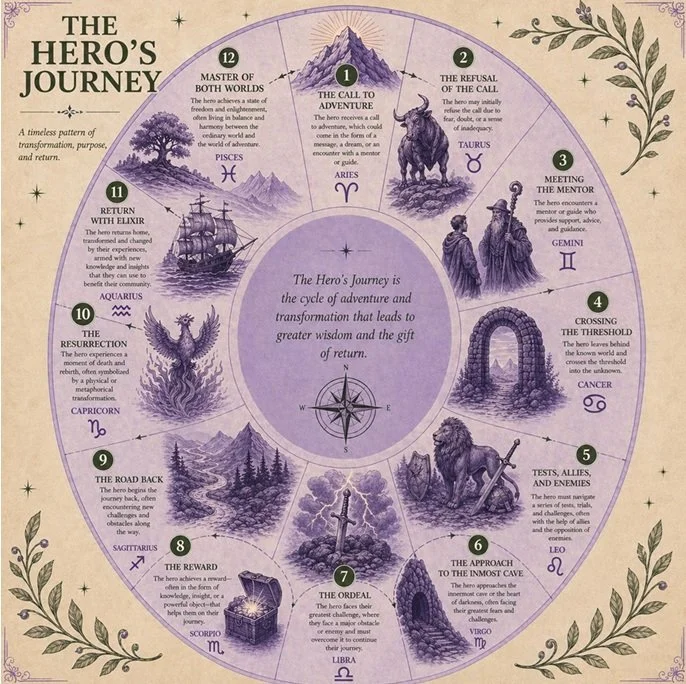
Overlaying the Hero’s Journey upon the Zodiacal Year
Instructor:
That would be a whole other lecture.
Instructor:
Yeah, that's a whole other lecture. That's like a whole little insight on that. It's pretty cool.
Audience Member:
Everything you talked about connected. Everything could be a whole other lecture.
Instructor:
Yes. Do you want to do a one minute summary, a 60 second summary?
Instructor:
Yeah, so, okay, all right.
So basically in summary, we looked today at the esotericism within Sumerian mythology as the parentage to the esoteric mythologies both of polytheistic and monotheistic traditions in the Western world.
We looked at Sumerian mythology specifically, also as a sort of seed religion that traces back to times before, when matter was still descending. I mean, sorry, Spirit was still descending into matter, and bringing around those traditions, as they rose towards a motion of ascension that all of our religions on this planet currently have now.
And we talked about the structures of how these traditions developed and moved over time, and then also at the esoteric symbology that exists within the Mesopotamian mythology, as it does in every religion, across the globe.
Instructor:
And we're going to put this online, as well, with a transcript, so in case you want to study it again, because it was a lot to go through.
Instructor:
It’s a pretty heavy topic, but it’s interesting.
Instructor:
But with more study, it should slowly sink in. But another big key was finding the Universal Thread. Because that takes us out of dogma and attachment and into a place where we can be curious, we can discover and experiment and learn for ourselves.
Instructor:
All right.
Instructor:
Okay, thank you, everyone.
