Am I in Coherence?
Play video below. You can read along with the transcript under the video.
There are many layers to what it means to come into full balance with the Great Reality. Mystics, seekers, neophytes, aspirants, monks and lamas all take up their studies and practices towards one aim. They may or may not be aware that COHERENCE in all levels is what they are truly seeking. This is perfectly balance. Before we can move towards perfect balance, we need to understand what it means in all its levels and also how coherence or lack thereof plays out in our lives. Enjoy this talk covering Coherence as a spiritual and energetic teaching to enrich and guide all people.
Am I in Coherence?
Series: Finding the Third Force - Class Three
Transcript
Today's talk is of a general nature. The title is Coherence, and before we begin, I'll just ask you guys what you think coherence is.
Audience Member:
Sorry, I don't understand the meaning of coherence.
Instructor:
Yes. I wanted to see what you guys think it is first, so you said, “I don't know,” maybe Lucy has a definition.
Audience Member:
I guess, similar to peace, or surrender?
Instructor:
Mmm. You could say those things would be included in it, for sure.
Audience Member:
So, this is a funny synchronicity. This was just last week. I was chatting with a guy on Tinder. And on my Tinder, I say “Amethyst is my name and energy is my game.” And so he messaged me and he said, “Okay, so if energy is your game, how would you describe your favorite energy that you've encountered, plant, animal, mineral, or other?” And then my response—and this just popped into my head in this moment.
I said, "Good question. I said coherence.”
Instructor:
Oh, wow, wow. That's a very good synchronicity.
Audience Member:
And I said, “That's what I landed on anyway, because it's so elusive, can apply to all and is so juicy-delicious when it occurs.”
Not to say a little lighthearted chaos can't be fun, but, you know.
And then, let's see. And then he said, “Curious to know how you pick up on coherence as energy, like energy that just makes sense or just comes together?”
And then I said, “Oh, I ask myself the same question. Is coherency energy?”
Then I decided, “Yes, I think it does become its own frequency when it occurs rather than just being the thing that harmonizes, if that makes sense.”
Instructor:
Hmm, hmm. Well, coherence has been—many have attempted to describe it using many different words. And in a lot of other teachings, they use words that are not the same as the words we use today. So things like equanimity, balance, inner peace.—These are all ways that people are trying to describe something, and using more modern language, we can refine what that actually means.
Instructor:
You could also say, alignment.
Instructor:
Yes, alignment is a very popular word, but these terms can be abused, misunderstood, misapplied, and then co-opted into something either adjacent or very far away, because someone wants to get on the bandwagon, but they just don't know what it is. So, they think "This word sounds nice, and I'm going to say that I have this thing that I don't understand, because other people have it, and I want it, too.”
Instructor:
So usually when that happens, a new term comes down to some of us who are listening, and this one seems to have popped up quite recently, actually, just in April, but it's been a buzzword around the community, but in that sense—as Ruth said—it aligns with a lot of the things we already talk about here, especially at our center, we like to focus on equanimity and balance and coherence, and finding the Third Force, so that we can disidentify from the personality.
Now, in that sense, we've actually done a series of talks on finding the Third Force already, so we can say this is the third in that series.
Instructor:
It would be good to define coherence. We have the table of contents here for what we're going to go through in today's talk. But just so we know what the talk is actually about, coherence is when different parts of our inner world are working in harmony. So, once we know the breakdown of what is inside of us, then we can understand if they are working in a more united fashion or in disconnection.
When the different parts are disconnected, then our field doesn't have coherence. It doesn't manifest correctly. It's like the thing that was made to do something is out of order. So it's not performing in its correct function. Like a frying pan, but it's upside down, or a paper towel, but it's wet, right? It's just not able to do what it's supposed to do.
So coherence is when everything is lined up, so our field can function. It's actually a reference to a baseline of just simply being normal, but no one is normal these days. Everyone is so out of whack that we're not coherent. That's how you have people that are full of inner conflict. Their mind and their emotions are going every which way.
We have a lot of students that sometimes approach us with some personal questions and usually it has to do with inner conflict, right? They say, “I feel like my heart wants to go this way. My mind wants to go that way.”

Indecision breeds incoherence.
Or, “I have these two options, these two directions, and I keep going back and forth, back and forth, back and forth, round and round. They both seem kind of right and kind of wrong, and I don't know which direction I'm supposed to go in, and I'm so afraid to make a mistake.” So they're all caught up inside of this story and this inner confusion that is preventing them from moving forward in their journey.
So coherence is like putting everything in order so we can just start to move forward. It doesn't necessarily tell us which direction we need to go, but it does have a correlation to that as well.
Instructor:
True coherence, we equate with balance and equanimity, but we could also say that coherence can be a little bit more of a broad stroke. So when we're thinking about the fact that it's more of an alignment, a frequency, that's why I use the word alignment as well. In the sense of, someone could have coherence and be in ego and be out of balance from the center. Now, in that sense, they're not in coherence with the Construct, with the Reality, with, with the inner authority, because true coherence would be balanced at spirit, soul, and body.
But they could have a lower coherence just within their personality, whereas equanimity and (full and true) balance definitely means in balance in the center as in internally and externally. So we could say there's a little bit of a broader stroke there.
But when we move forward with this, the first thing that keeps us coherent and is the question, “Who am I?”
Does anybody want to take a crack at that question?
Audience Member:
No.
Instructor:
Oh, there's many things we could say. We could say, “I'm an immortal being. I do not die. I'm eternal.”
We could say, “We are nothing at all, just energy that resonates with a form.” There could be different levels of understanding of this to an extent, or we could identify with the person.
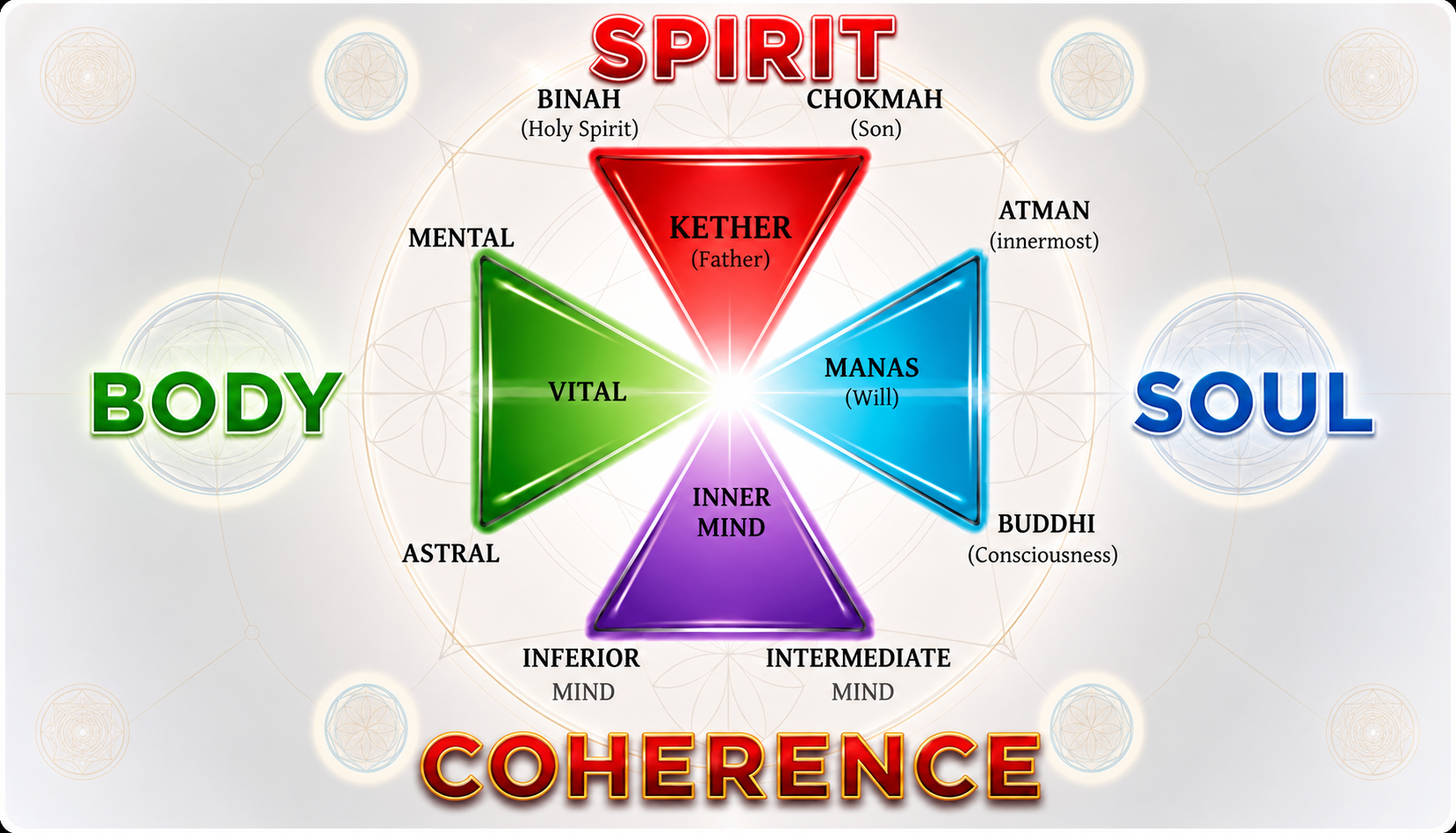
So there are three levels to it, really. We say there are three minds. And the first part of coherence is identifying where we are in the vibration of what—which of those three minds, and then bringing our emotions and our actions and our willpower together with that frequency.
So, in a sense to be coherent with the actual universe, the actual solar system, we would need to be in coherence with the Inner Mind—the mind of Unity. But that would be the, “I'm not this, nor am I that, but that which resonates with both, that is also nothing.” So the life force itself, the energy itself, that comprises everything that we are and everything that we can be. It's beyond even the consciousness in being, right? Beyond the observer, and that which is observed.
Instructor:
In a lot of Eastern texts, they describe the source of suffering as coming from identification and coming from misperceiving reality—so identifying with the physical form, thinking, "That's me!” and then becoming attached to its story, where it's going, and really we are the awareness behind it.
But imagine if you were watching a movie that was so convincing that you just got stuck in the theater and you never left. And you never did anything outside of the theater and you just sat there. Well, you would get sick, right? You get real sick and, of course, eventually you would die, right? You can't stay stuck inside of that illusion. So the soul is in the state that it's very sick because it has misperceived the Reality, and it's completely misperceived, not just the form that it identifies with, but the whole nature of reality.
So some basic things that are often taught in Eastern teachings, they will say, "People don't understand impermanence.” So this is one of the big things that they fight, right? They want everything to be permanent, like a relationship, like a happy time, some happy moments, or good food. And the nature of reality is that nothing is permanent. So they keep getting upset. “Why did something I liked end,” right?
“Why did that relationship end?”
“Why did that place where I was employed? — Why did that employment end?”
“Why did the people I love pass away?”
“Why did my dog die?”

Suffering is self-generated in the mind.
All of these things, as if they expected it was never going to happen. And that was the misperception of reality, what they refer to as ignorance. And, these days, we don't really use that word in modern terms it sounds like you are looking down on someone, but in the ancient scriptures, they said, "Oh, it is ignorance. They're just completely misperceiving reality. They're asking for something that cannot be.”
And then, of course, there's the classic craving & aversion where we run towards something and we run away from something. And in Buddhism, they say this is the cause of all suffering, right?
“I want this thing that I didn't get.”
“I don't want this thing that is coming to me.” And the more we create this resistance, the more we create unhappiness. And we keep wanting to blame the circumstances, not realizing that we are the one that's generating the suffering by our misapprehension of the arising events.
So the question, “Who am I?” is a very powerful question, if we can comprehend the answer. And how can we move through life or do anything at all if we've got everything completely in the wrong place, right?
People say, “Oh, I want such and such an employment. I want this kind of a reputation. I want whatever, fashion, beauty,” whatever it is that they're chasing, and they keep grasping for some kind of feeling that never arrives.
The brain has this trick, right? It promises a certain amount of dopamine that it never delivers.
So, unless we can answer the question, “Who am I?” It doesn't really make sense to keep going forward with all of these things that we're chasing because we haven't yet understood, “Who am I? What am I doing here?” And then I can wonder where I'm going. But a lot of people don't want to ask that question because it frightens them.
Why do you think they might be frightened?
Audience Member:
I mean, I certainly know that I definitely have that issue. That's kind of what I'm struggling with right now, because I'm going through this massive shift and change, and so I'm trying to land on, “Who am I?” And it is scary.
But when you're asking, why is this scary? I'm like, I don't know.
Why is it scary?
Instructor:
Yeah, that's a good question, right?
I feel that a lot of people are afraid to ask this question, because they're afraid that they won't know the answer. And then they'll have asked themselves, an impossible to answer question, and they'll be stuck going, “Great. I don't actually know who I am,” but as long as they suppress that question deep enough, then they have this kind-of-sort-of-maybe feeling that they know who they are, which is an illusion.
We go through a journey in our incarnation where when we were born, we are pure and innocent, and we have not yet taken any conditioning of the world to create a personality. And later on, we are trained by society and our environment to identify as “the body”.

Our true nature is incorporeal.
Funnily, there are some initiates who have awakened to the level where they remember their memories from when they were a baby. And they remember, as a baby, they were completely the awareness energy that was not stuck inside of the body. It was kind of related to the body, but it knew that it wasn't the body. And according to one recount, this person said, they didn't know that other people could see them as the baby. They just thought, This is a story that's arising in the awareness, here are these figures. This is very interesting. There's that baby-body, and by and by as people began to talk to the baby and call it its name, then it went, "Oh, shoot. These people can see me, and they're talking to me, and somehow my awareness is related to this form down there.” And then slowly, of course, then they were trained to feel more and more like just the form, and not the awareness that was around it.
But we say that the awareness that is around the form, we call it the Observer. And a lot of people say that they can't hear their thoughts, or they say, “Oh, I've already conquered the mind. I don't have any thoughts.” And really what it is, is that they're so identified with the physical form. So asleep, that they can't find the Observer. So they have no ability to be able to watch their thoughts or to observe how they're feeling, how they're thinking.
So, we go through this process where we become more and more identified with the physical body, which is a vehicle, and then, at some point, we begin to stack these layers upon this identity. Like, “I'm from this town. I was born in this place. These are my parents. I studied nursing. I'm gonna be a paramedic.” Something like that. And we layer up all of these things that we think we are. However, if we were to remove all of those labels, we'd find that there's still something there.
People say things like, “Oh, if only I had their body,” so that means, okay, you know you're not really the body. Otherwise, why would you wish to go into somebody else's body? You had a sense about you, your you-ness, that understands, even if it's very, very buried, that somehow there's a part of you that's not related to your body.
And so we build this identity, and we become very attached to it, and it's these attachments that are like energetic chords that begin to pull us in all different directions and cause a kind of incoherence in our energy field. Because really, if we understood what we are, we are pure life energy. We are not a person. This energy can go and manifest in any kind of form and have all kinds of experiences. And when it's functioning correctly, then it can be a very powerful field, and something called the consciousness can awaken within it.
If we are too identified, then it's very difficult for the field to work correctly, and for us to contact these parts of ourselves, the awareness and the consciousness. So it's an important question, but the answer to it actually comes from becoming nobody again. So it's like we go through a journey to create an ego, an identity, and then later, in order to be free, we need to move back into a place that is less attached to all of these strings. And that is going to free us to play any role, but much more lightly.
Instructor:
Yeah. We talked about in the series already a little bit, how to find that truth that is at the center of the reality, the unity, consciousness, life force, the spirit, right? And in that sense, that is the Third Force that we're looking for, the force of conciliation. The force that creates within duality to have experience. And we've talked about, we find that through being in the center, and that center is the center of spirit, which is already always there. And then balancing that with our soul, our higher self, and our body.
But that supreme coherence, that supreme equanimity, comes in layers, because as above, so below. So the question of, "Who am I?” will also relate to what it is next we need to establish coherence in.
So at the beginning, right, someone who is not awakened at all, in ego, let's say they want to manifest, like black magic, and they want to create something, even though it's going to be karmic, they want to get themselves a car, right? They simply just need to align their lower thoughts and their lower emotions with their desires, and their egoic will. In that sense, they would be at that level, in coherence, although out of coherence with the higher Self and Spirit.
So the first thing we seek to balance at our level, right here in the physical, with our body, is to balance our mind, our emotions, and our will to align with the will of our higher self or the Observer. So, we do that through self observation, and we start to understand that we are not the person, but rather, in this case, we are the one who is observing that person.
And at that stage, we can see how these programs of the lower intellect cause us suffering and pain, and then through balancing and finding the higher functioning emotions and the higher intellect from the higher self, and by bringing that into balance, by bringing our energy into balance, the creative energy within our system, we can then finally connect to the will of the higher self, which will then connect us to the soul.
And from that aspect, then there's still more that will need to be balanced because we have, if we balance in our lower self, then those higher emotions and higher intellect, and the will of the divine also need to be brought into balance. And eventually, those superior emotions and the lower instinctual functions also need to be brought into balance to truly connect to the Spirit that is already there, the Inner Mind.
But first we start off with just the simple functioning of just literally having our thoughts and our emotions and our instincts in check. And then it evolves into going into the unconscious and balancing these other higher things, our intuitions with other things like that. And the will of what our mission is and things like that.
But we need to start with coherence at one level, then coherence at two, and then we'll connect through and have that moment where we AWAKEN.
Because the actuality is, is that we are neither the observed nor the observer, but first, we need to observe the part that's unconscious and asleep and detach from that. so that we can then find that center, which that center point is there.
But we also need to be careful not to miss it, which is what we see with, people who get religious or dogmatic. We take a approach towards the observer, and then we shift our identity from here onto the Observer, and then we become a “spiritual master”.
A true master would never call themselves a master. So that is always usually a red flag. And all of these things, we need to completely shed identity and find humility. And humility isn't what the religions tell us about being meek and quiet and pulled back. Sure, it is absence of arrogance and all of that, but it's really an absence of a false sense of self. So it's in the middle of that.
We don't want to be inferior and then beg higher beings and all of these things either because that's also out of balance to the other way. Inferiority is inverse pride. And if we take an approach that “we need help from something external, that we need to be subservient to something external,” then that too is still pride because we still see ourselves as something and something else as something.
Whether we see ourselves as a really good, godly something and we're full of ourselves, or we see ourselves as weak and needing help, we have a false sense of self. So we're not in that center. And therefore, we don't have coherence across all 3 of those planes.
Instructor:
The other thing with identity is that in modern society, everyone around us is so identified that they're pushing us to also be identified, right? Misery loves company. So, you go to a workplace, and maybe somebody coaching or mentoring you will say, "You need to decide what is your personal brand. How do you want to be perceived? You have to invent yourself and put your best foot forward,” and what this leads to is someone creating a very false version of themselves, full of 10 different masks, and it can lead to anxiety, or just a sense of being out of alignment, out of balance, because they're projecting a persona that has nothing to do with who they are at their core, but they feel that this is who people want to see.
“This is who they expect in this kind of environment. So let me invent myself.” And this doesn't allow them to be present, and to be authentic, because they're busy trying to please everyone around them with a mask that they created. And then everyone has to buy into it, and it's very, very stressful, and it takes a lot of effort to maintain the illusion, and it becomes a case of you have all these people together playing this game, where they're all pretending to be such and such a way, “so respectable”, and whatever it is that they're boasting about, to look superior, or to present a particular, carefully curated brand, that's not really who they are.
Now, this is not the same as being clear about your purpose and your mission, and the direction that you intuitively sense is right for you. But we have to be careful because the ego — which is of time and of attachment, and which leads to suffering and the experience of limitation in our reality—the ego always wants to know what's coming next. It wants something that is reliable and predictable.
What we said at the beginning of the talk is that nothing is permanent, and craving and aversion needs to suffering. So if we apply this expectation of wanting things to be predictable and “just how I planned it, how I expect it to be,” we're setting ourselves up for disappointment.
So we can't maintain the mask all the time, or it takes a lot of energy, and we have this very, very quiet, inner voice that says, “I'm slowly dying inside.”
That's what we call in the Gnostic teachings, our Essence. The part of us that is more fundamental, that does move from incarnation to incarnation, or we could say rebirth to rebirth. That is not the same as the personality in the body and the name that goes to the grave. The Essence has a unique expression, a unique flavor, and a unique mission in this incarnation. But if we're so busy trying to satisfy all of these so-called identities and, "How do you want to show up as today to meet some societal requirement?” then we'll completely mask and bury this essence, which, for the majority of the people in the world, 97% is masked, doesn't express.

The Essence is the pure part of us, like a baby.
So they have this feeling that they are dead inside. And you can find this out when maybe you get someone to do a deep meditation and you say, “What's in your subconscious? Make some little black box,” and they open it, and there's a skull inside and they say,
“Well, I don't know what this means.” Well, you feel like you're dying inside. You are killing that part of you that is truly alive, or was, and is not able to find its way to make its expression in a genuine way, in the world.
So, in the Gnostic teachings, we say that, "Who am I?” We are truly our core or our essence, our central part, and everything else is just like a bunch of smudges on the window that obscure the truth.
So if we can do a kind of work to gradually clear that window so we can see clearly, when we are clear and clean on the inside, then the outer world also starts to reflect that. If everything around us feels like a storm or chaos or a lot of conflict and “I'm confused, should I go this way or that way?” That's a reflection of an inner division. A lack of coherence on the inside.
Once we understand that we are the Essence, then we can be willing to slowly give up these identities, these masks, because we know they're not who we really are.
Instructor:
You talked about the Essence, and the Essence, really, what it is, is our personal, individual, divine spark, or the piece of that awareness, that Life Force itself, not even the consciousness, but just that which animates everything that's around us, whether it's, you know, the table, the floor, you know, people, plants, animals, all of it. Everything has this energy within it, all matter at any energy level.
And then beyond that, we have the soul and the body, which can respond to our consciousness and our physical form. And that's what allows us to perceive, because without that, the Essence contains everything, but it really, it’s nothing. Even beyond, it has no perception, right? There is no I. The I is a consciousness, even on a macro scale.
So in that sense, that's part of the reason we are here. But even this question also can change where we're going through from where we're at in our development. We get there slowly.
At the root of this question, if we're in coherence with the Spirit, we would relate that to Divine Purpose. And the divine purpose is related to the fact that at unity, our existence and our reason for being here is to awaken and to perceive and to extract wisdom, to learn and grow. Because the Law of One states, that the reason for the being to be is just to be the being. And at that, that is to just experience and grow. So, in that sense, the Divine Purpose is to awaken the consciousness and help others awaken because others are also us.
Of course, we help those that want help because those that don't come for help are at a stage of development where they're learning through experience in a different type of way. So it's not to force anything on anyone, but to just help those that come and seek, for they are also you, and at a different stage of development. But that's the Inner Mind.
The next level down related to soul is where we see mission and mission is our own unique individual expression of purpose and how we do that in the world. That’s something we will find earlier (Very Likely) before we find the Unity Consciousness.
But that's the First Thing we are trying to achieve, just as in—we said before, the first thing we need to do is to find the Observer and to start observing and disidentifying from the lower person. Because the higher ego or these higher states of perception are not unconscious. They're connected to Source.
Sure, there's something subtle that keeps our Beings separate from each other and angels separate from each other, but they're not unconscious beings. So only in the human condition are we unconscious. Only in the human condition do we taste illusory desires and material things. So the first part of the work as it is to become that Observer and to pull away from the lower self, that is also where we find the connection to mission.
Because if we go down one more level yet still, as we said, the, "Why am I here?” becomes horizontal line material things (Note: Horizontal Line is a Gnostic term referring to things related to the material incarnation only as opposed to the development of the soul and Spirit.).
Maybe, it's different for everyone, whatever egos they have, right? But it might be, you know, work-related, financial-related, maybe just simply pleasure related, but it's still something selfish and for that lower self. So the first thing we do is we find soul, we find that mission and that will power from the higher divine to drive to do the work.
And as long as you don't get obsessed with it, then that will springboard us into the Unity and the Third Force of conciliation, which is in between the two.
Instructor:
When the mind hears this question, it can have a kind of anxiety, like, "Oh, quick, I better answer this. I'm supposed to be doing something very important. I better find it!” And of course, it's important to use the incarnation for the intended purpose.
It's probably not going to be the first thing the mind thinks of that says, “Oh, I know what it is because I want to get rich. So it better be this kind of a business that I should start. And then I'll be successful. I'll be famous. And now I know why I'm here.” But that whole plan could be just related to some figments of desire and some influences from some people that lived across the road, and none of it is actually part of your soul's mission, but it's just a hodgepodge of different events that you put together and said, “Ah, here! This is it.”
So it's not necessarily something we need to answer in a hurry. It's something that we need to find out moment-to-moment and more intuitively.
“Why am I here?”
And when it feels right, we will know.
Instructor:
But obviously, that's why we said that why am I here is really simply just to be and to have the experience in the first place. We do have some younger people here, for example, when we talk about mission, mission, even if we're connected to soul, as a young person, it may not be clear yet, usually mission comes together, if we are conscious at a later stage of life and doing work on ourselves, it'll come together.
But first, a lot of the times the mission would be at our young age, to still explore and have experience that will then gear us towards understanding what our mission is. So sometimes if we're too quick trying to figure that out and what mission is, it could be that, that's just an ego, and it could be at our moment, we're still just meant to be in a state of learning, and everything will kind of coalesce and come together as needed, when it's supposed to happen, but it does come from connecting to the Higher Self and being in observation and being able to see the differences between our desires of the lower self and the divine willpower from Source.
Instructor:
Yeah, and the point is that it doesn't necessarily—just one second (a student is raising their hand)—it doesn't necessarily have to satisfy the definition of success or something that society puts up on a pedestal. It's very possible that it has nothing to do with any of those things that society values because in this time, at the tail end of the Kali Yuga, the majority of society values egoic and unconscious kinds of things. So they're not going to put the same emphasis on something that is right for your soul.
So, a mission, in some cases, for some incarnations, could be something very, very simple. We said fundamentally, it's to be, right?
And I'll share a brief story.
There was a doctor who didn't believe in anything beyond the physical. He was simply a medical man, and his son, at 19 years of age, passed away, suddenly, in an accident.
The son was on the spectrum, and he had grown up with the family, and then when he got to that age, they were saying, “Well, where can he go now?” And they found a place that was in the countryside where young people who were on the spectrum would live and be looked after.
So they had just recently settled him into this facility and everything was very nice and pleasant and it was beautiful in the countryside. And somehow, the group had gone on an excursion in the woods with their caretakers, and then the boy had gotten lost.
And then later, they found him. He had fallen over, and his face fell into a river, and somehow he had gotten confused (and fallen), and he had passed away.
So him being 19 and having just grown up and moved out, and they thought he's going to have this happy life at this facility in the countryside, and he was such a sweet spirit, and everyone loved him.
It was devastating for this couple and they didn't even have any spiritual connection. So to them, that was it. Our son is passed, and they were very, very much in terrible grief.
And then, both the husband and wife had transcendental experiences where the son’s awareness came and visited them. And then suddenly, they had to believe that there was something beyond the physical, and they knew that he was okay.
And during this whole process of grief, the father, who was particularly affected, his son would visit him for a series of visits to help him heal, until he was completely healed, and knew his son was okay, and then he said, “Okay, I'm not going to visit you anymore.”
But when the son came to visit, he was giving his father spiritual instruction, and he would arrive as an awareness, and then the information would start being transferred to the father. So he was learning about these things, and he actually, as a side note, this father put his medical career on the line to come out and write a book to tell everyone as a doctor, “Now I believe the spirit world is real. I can't deny it. My son has been visiting me. Call me crazy if you like, but this is my experience.”
One of the things that his son told him was that, "My only reason for this incarnation was to come into your lives, and to just mess with everyone, and to push your buttons, and just be that playful disruptor that would cause you to snap out of yourselves and your ego and all your trips and the little things that you were trying to do,” because he was on the spectrum.
So he would always be doing something crazy and annoying, and then they would go, “Oh, no, we're trying to do this, and now he's disrupting us, right? He's rolling down windows and he's throwing things out of the car and we can't manage him.”
And he was just there to be a nuisance. But he was a high soul, and he was, there to teach them by being an autistic child and frustrating them.
And of course, so it made sense when he grew up and they sent him away to a facility, he didn't need to stay there. He was there to give them instruction. And now he was happy to drop the body and leave.
So, our mission can be something very simple. It doesn't have to be something grandiose with a massive influence. There are characters that have those kinds of missions, but his mission was to mess with people, and he did it.
Audience Member:
Oh, I was going to ask you a question. About, because the thing with nursing school is, I was so locked in, and that was an environment of an earlier thing, a kind of more like a revolutionary thing, not like a refinement of what I think my purpose is, and why I'm supposed to be here.
And then, now, obviously, I'm pursuing this thing (new chosen career), but it's like should I even be trying to self-evaluate myself?
Like, this is really my purpose. I was going to ask, so what I'm getting from this is the key is just not to be too attached to it. Not throw everything, because I'm not going to just throw everything out the window and then, because family, career thing, like the multiverse you're talking about, I'm thinking, "Yeah, this is totally a different multiverse than Spirit.” It's like a different family and then like a family (referring to the spiritual community), your blood family.
I definitely see those as different multiverses, in my head, and there are links between them.
But, what (should I do), just don't get too attached? That's what I took from it.
And I was really happy to hear what you guys said, like when I was processing, I was thinking, “Oh, this sounds very good.”
Instructor:
Yeah, detachment is obviously the goal in depersonalization to truly have that awakening. I mean, we could say, there's a lot of things that can turn around as awakenings and to a certain extent, and little leaps, maybe becoming aware that there's not just a third dimension through, a psychedelic or something, or, you know, becoming aware of the observer as soul.
But really all of those things still exist within the Matrix. So the true meaning of a spiritual awakening, and we think of spirituality, is that first connection to the Third Force, it's of Spirit. And that's something that comes over development over many, many, many existences and manifestations, okay? That's not something that just happens in a certain amount of time. But that would be where you have the detachment or the disidentification, the salvation, liberation, freedom of the consciousness for the first time, right?
In that sense, that (true awakening) comes from the place of detachment. There are stages to get there and there's things we have to work through. It does, to an extent, first, we have to develop moment-to-moment awareness, and be able to observe ourselves and develop a practice where we can actually meditate and...

Audience Member:
...go into actual meditation.
Instructor:
We have to be able to meditate and be able to contemplate our actual false sense of self. Once that's achieved, which actually doesn't necessarily take too much time, what the real barrier then becomes is that we have to face ourselves, because the only way we can detach and disidentify from the person is to actually comprehend and comprehension happens in the moment, which is to perceive all of the perspectives of our own false person to the sense that we see it as an illusion. And then when we see the illusion that it is, we then thus detach from it.
And then, and then at that point, truly, is when we could actually do the work of initiation, we could take external initiations from a school. We even give external initiations to a certain point. We could even take internal initiations from the ego, which is why people can be on a right-handed path or left-handed path and still feel like they're initiates.
But true initiation is when one connects back to the Unity, that is the Spirit, and they find the inner school, the inner master, they become their own teacher, and they start receiving initiations from the internal school in the internal planes. So that comes, that has to happen from depersonalisation.
And also just the work in general, that comes with initiation. If we follow those methods and we can't actually see the ego for what it is, then we are working through a spiritual ego or mystical pride. So in that sense, is if we can't fully see the ego for what it is, then we can still dissolve egos. We can awaken consciousness through conditioning, which we've talked about here before, but we're working from an ego to then...
Audience Member:
Remember, to destroy other egos, what?
Instructor:
Well, what happens is that because we work with the creative energy, is that when we use an ego to destroy the other egos, we also strengthen and increase our attachment to it. So that's why you see people get dogmatic and religious and all this stuff because the ego that is that religiousness is being strengthened by the work to cleanse all their other traits that they do see about themselves.
So to an extent, they can increase to a certain level, they can awaken to a certain level, they can even awaken their soul, all of this, but eventually they'll reach a point where they flatline; there's complacency, because they don't see what they are still attached to.
They haven't actually awakened from the illusion. So they're using the illusion to gain power in the illusion, which we can do.
We're at a starting point, we're very, very limited and asleep to what we even perceive from the illusion itself, right? You can go through a whole experience and we do over many, many years. That's why this gets... many, many existences. This is why it gets imprinted on the Spirit because of all the “failures”, but not really failures, it’s development that we've had over time where we follow up away and then end up getting trapped, right? So that thing is true.
You could have a whole experience if it was a very young, very young soul, very young spirit, where it was just becoming aware of the 5th dimension, which is where we dream every night, is so profound, and they spend their whole life just working on dream yoga and trying astral project, and all of that. And they don't even awaken to their Higher Self, much less, to the Spirit.
But it's a stage of development, and that's—and we have to understand that there are a vast variety of differences between the beings that have already done work in initiation and are here right now trying to help the population and the actual population on this planet, that is still attached to the consciousness of the earth, which is the majority, because it is the Earth...
Audience Member:
I was going to like their First Chamber meetings. Basically, I've been trying to have strong dreams, like lucid dreams, like astral projection. Like, what I'm interested in.
And then they said, take your cookie or whatever.
And then I had a crazy dream. Like I was flying like a jet. I was doing cocaine in my dream, it was craziness.
And I became lucid in my dream, which I hadn't done since I was 12-years-old. And I didn't even realize, and then after I woke up. They said that the other day.
I just want to give a recommendation.

Instructor:
Little by little, right? So when it comes to the dream world and dream yoga can be a very useful tool for self-evaluation. But, first we have to be conscious while we're awake before we become conscious while we're asleep. And that's basically how it works.
And yes, at the beginning, the Higher Self or Being can give us experiences kind of as like a treat, because really those powers come from the higher self. So they could just turn them on if it wants, even if we've done no work. But that's just to show us that it's real when we first start truly dedicating ourselves to the meditation and the practice, we have a lot of experience at the beginning sometimes.
If we're doing the work appropriately, a lot of people come in and they don't have experiences partially that could be because of the style of work when you come in with this religious mentality. Although it could also be just for their experience too as well.
But at the beginning, usually, if we are going to have experiences, we will have them a lot in the beginning, very, very, very powerful, and it's kind of like a, "This is what you can have.” It's like, what would you say, like a treat or something?
Instructor:
I call them freebies.
Instructor:
Freebies, yeah. And then they'll be taken away because it's, “Will you still work when you don't have this, now I've given you the Gnosis? Yes, it's real. Now will you do all the hard work to actually create those abilities within yourself?” Because, again, those abilities are attached to soul, and until we incarnate that principle and purify the body, to actually connect to that plane, then we're not actually doing that ourselves, but we can earn those abilities to be under the control of ourselves by doing that work, which the work itself takes a long time.
Awakening is in the moment. The level of being is in the moment or level of consciousness is always now and in the present. But the work and the purifying the body as in initiation, dissolving the ego, all of that, is in the horizontal line, and that does take time because that is the work and matter.
I always like that Jesus quote that he said to Nicodemus, "Let that which is of flesh, be of flesh, and but that which is of Spirit is of Spirit.” The true spiritual work, even at that level, the most meta-level, is always in balance. So we actually have to do the balance, work on the consciousness and the work in the physical matter. Because if we do too much to one way or the other, we, again, flatline.
So if we just awaken, awaken, awaken, and this is something that happens, I think, with a lot of non-dual teachings, is we can awaken so much, we've connected to the Unity. And then this ego will creep in, that doesn't want to accept the true nature that we exist to exist. So it says, “Everything's illusion, so I don't have to do anything.”
But the problem is, is that to actually—even though we can connect to the Spirit in this high level of consciousness — to actually pull down and receive that into the body, we need to actually purify the nerves and it is a slow process of increasing the ability of our body. We call them solar vehicles in Gnosis, but we have to re either create or reestablish ourselves in these higher subtle bodies to absorb more of this, the frequency that comes from the divine plane.
So it doesn't matter if you can connect to it, if you don't have the vehicle that can receive it, then you get stuck until you build those vehicles. And the other — the flip side of it is — the people that get into that spiritual warrior mentality that never awaken the consciousness and they have that ego that just wants to do the work, well, then they can create the bodies, they can, again, like we said, they can lower their filters to some extent, and the conditioning remove some of the ego, but the ego that they've worked with strengthens, they strengthen that one, and they become, they become what we would call a Hassnamusen, they have a double center of gravity.
So they have the higher bodies, but they also have (lower) ego. And then thus the ego can use those bodies. And they're actually probably the most dangerous people on the planet. Of course, you know, all relatively, but it’s just a stage of development. They have all the abilities, all these things, but they use it for personal gain.
Instructor:
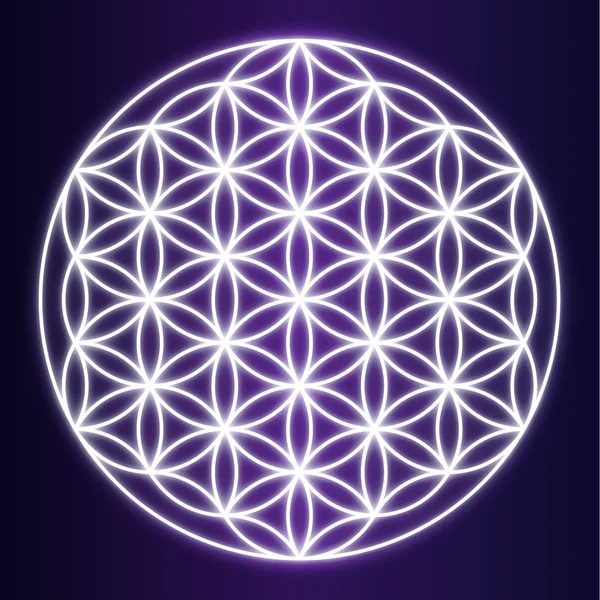
So you guys can see the Flower of Life, the sacred geometry, right? And all of reality is built off of geometry. It's the One that keeps dividing itself into equal and opposite negatives, and then overlaying all of these fractals on itself to create this illusion. And it works off of perfect mathematics, perfect geometry. So it's like a grid that you can move through, we could say.
It's a little more complicated than that, but just to put it simply, when you are aligned, you are working with the grid, and when you are not aligned, you are working against it. So if we say, this is a perfect shape, and then you're over here, right? (demonstrates a body position) Whereas if you are in that shape, you are lining up with all of the energies that trickle down from the higher planes.
Because we are a crystallization at this level of density. If we peel it way back, it's just an energy soup. Having an experience of awareness. But it's manifested or expressing at a slow enough vibration for there to be a crystallization or a density that gives us this illusion of solid material.
And this works by something very, very subtle, in the highest planes, coming down, down, down, and increasing its density until it arrives here. And this stream is continually coming down. So when we are in alignment, it's like putting out a bucket, and you catch the rain. If it's in the wrong place, you catch nothing. So the alignment, or coherence, is when all of the parts of our self that, in most people, are in the wrong place, come into one, so that the energy from up high comes down clearly.
And so, there's different ways to define coherence, but essentially, it's an energetic lining up to receive these higher energies, and our mind, our emotions, and our will, which we'll talk about in a moment, are actually defined as different planes that this density moves through to render this person here.
When you see a person here walking around, it's like, imagine a puppet show, and there's a puppet, and there's a guy behind, and he's putting his hands inside the puppet. The puppet is moving. So in that way, you see a person here, but there are higher and higher things that are all animating and creating the reality in this denser level.
So, when our thoughts, our emotions, and our will are divided, meaning they're working against each other, like the typical one is, “My heart is saying, yes, and my mind is saying no,” right? When we're having this kind of incoherence internally, and it often happens when someone says, “I love this person, and I love this person,” and they're going back and forth. They can't decide and they say, “Oh, I don't know, what should I do?” You have some terrible cases where they make a love triangle and it leads to suffering, right? Or they just can't decide and they say, “I choose neither.”
Whatever the case, the longer they stay in that divided state where they haven't chosen which reality to manifest, the longer their field is not in coherence. And when it's not in coherence, they can even get sick from it.
So, lovesick is usually someone that, their actions or their reality is such that this person is not here, and they're saying, “I wish they were here. I wish they were here. I wish they were here.” Then they get themselves sick, right? They're asking for something that's not here. They're not being present.
So, to be coherent is to line up with this sacred geometry, and to put ourselves in the position to receive these forces clearly.
Instructor:
As you already alluded to a little bit, at the most base level, and I think I also said it a little bit earlier in the talk, coherence is the alignment with the three centers that we have. We say we have three brains in Gnosis, one related to our intellect, our emotions, and our instinctual-sexual-motor center.
And at the base root of it, it's related to this intellect, emotions, and we say actions, because, like we said, you can align, in a sense, with the ego, but we like to look at it from a more macro perspective as well, because on the macro level, what I was going to say here too, is that if we look at the fact that the sun or the solar system is a being that we are all within, and our Essence, and our body and all that, or the little fractal or a piece of that one larger being, then spirit, soul, body, that we have to also bring into coherence to connect to that inner mind, is actually our little personal piece of his mind, his emotions, and his body.
So in that sense, that's why we look to will in the lower, in our physical sense, because if our will is not aligned with the will of the divine being, then while we can have coherence in this physical reality to manifest with ego, we will never be in coherence with the spiritual or the soul, as long as we aren't connected to that willpower. So in that sense, that's what we need to align at all times is the will, the will of Divinity or Source, whatever you want to call it, with our emotions and our intellect and our mind. And that's because, as we said, as within, so without.
So as we find that coherence internally, as we get to those states of equanimity and balance, then this will reflect outward into our reality. So, that's literally why people who manifest also talk about this, even in an egoic way. But if your vibration is in alignment inside, it will create the corresponding vibrations in the reality around you. And in a sense, we are constantly creating all the time, whether we are creating unconsciously or consciously, is one thing. Also, whether we are creating in balance or out of balance is another thing.
The reason we want to create out of that true center, aligned with the true north of our being, is because we create from the center, there's no reaction to it. It's created in balance because it doesn't have the issue of cause and effect. There's an equal balance of positive and negative force. When we create out of balance, whether it's for “good” or for “bad”, it creates a slingshot effect that needs to come back.

When we create away from the center (from imbalance/ego/desire), we create a karmic “rebound”.
An interesting way to look at this is if you have water, and if you were to you have a pool of water, if you tap water in the middle, the vibration goes out, it will come back into the middle. But if you tap at another point, just outside of that circle, the vibration will actually go to a point on the other side and then also still reverberate back. But you're creating 2 points. So that, in a sense, we could say, is related to karma, dharma, and other things that were not necessarily talking about.
But when you create through one whole duality, the equal opposite reaction must, must happen. So, that's why we want to try to create from the center and that center is usually in alignment with the will from Source above.
Instructor:
Coherence works in different levels. We talked about the mind, heart, and the actions, and we'd say the first layer of moving into coherence is whether you are acting from ego or not, it's still better to be coherent.
We recommend to not act from ego, because there is another kind of reverberation or something that gets returned back to you when you act from unconsciousness, or from desire. But before we can deal with that, because that takes a long, steady, internal work to gradually chip away at our shadow, we should first come into inner alignment, regardless, right?
So think of resentment. Where does resentment come from? It comes from when we are terribly out of alignment. Someone is doing something that we perceive to be harming us. Now, they may or may not be actually harming us, because there's an egoic part to it that could be telling stories that perceives them to be harming us when they're not. And that's the part that makes it a bit tricky. But before we can go deep and dig up our skeletons and our traumas and realize which part we are responsible for, it might be good to just get away from that situation because we're making more and more resentment, and now we've got two problems, right? So we don't just have the trauma that causes the stories of "You’re being mean,” but we now have the, “They're being mean to me and I hate this, and so now I'm mad at them.” And when we're mad at them, we have this resentment, we're still torturing ourselves. So that's why we say it's two problems.
To be coherent is, “Okay, if my emotions are saying, oh, this person feels nasty.” So I don't allow them to keep walking all over me and abusing me or stay in this situation where there is a kind of perceived harm, whether real or imagined, that if a part of me is saying, “This is not good,” and then another part is saying, “Oh, but, you know, we have to, da, da, da, da.” So these parts are not working together. This is not coherent.
And the deeper part is, it could all be a big story. It could be imagined, and this person is just being normal. We don't know. Uh, depends. You have to meditate in order to find out.
But if someone is, you perceive that they're harming you in a relationship, and you can't hack it, you can't figure out what's going on, best to get away from that scenario. And this doesn't just apply to relationships, it could be a job, it could be all kinds of things.
But this is a very, very entry-level part to this puzzle. Because karma-dharma will come into effect. These are parts of the nature of reality.
And we haven't taken this into account yet, because if there is a karma that involves the situation, then it's not that simple. If we are paying karma and our job is to be serene, we clear that energetic imbalance. If we run away, that situation may crop up somewhere else. So that's why it's not that simple, but we need to find a way to balance our mind, our emotions, and our actions while we figure out the other part of the puzzle.
And this can be a gradual journey where we're working out what it is in our shadow, in our subconscious that's feeding into the equation that's attracting these kinds of people, because the subconscious or the ego is related to our karma, and when we can understand and dissolve that, then the situations will stop recurring. But in the meantime, if we need to do things like create boundaries, create space, be assertive, we have to do all of those things as well, so we're not sitting there stewing about something that we think is their fault, but also pretending to be a victim and acting like we don't have any choice to walk away, or to say, "No, thank you,” or to take some kind of action.
Sometimes it can be something very simple, where we don't assert the reality that we're manifesting. Maybe we don't care, but we don't say yes or no, or I'm going to do this, I'm going to do that, and we leave it up in the air. If we take it back to the love example, think of someone that's dating someone, but is playing hot and cold, right? So they don't want to choose a reality, in a sense. They want to say, “I don't know. I don't know.” And then after the 10th date, or it's been 6 months, and they're like, “I still don't know, but yeah, I want to see you. But also, I don't know if I want to see you, so I'll just keep seeing you.” Six months should be enough for them to know, right? But they're essentially straddling two different manifestations, and they're not snapping their field into a coherent reality. They're not making a choice.
And we can do this with not just love, we can do it with work or with hobbies, with things that we're studying, or most importantly, our spiritual practice. Think of someone that says, “Yes, I want to work on myself, and I'm going to meditate every day for starting with 5 minutes to build my habit.” And then they do it every other day. So they haven't necessarily chosen a reality, because they're saying one thing, and they're doing another.
So, their mind and their heart and their actions are not working together. Their field is still having parts of itself that are working against itself. So the manifestation is going to be not guaranteed. It's a little bit of this, a little bit of that.
Imagine if you make a cake and you say, let's mix in some soy sauce and some garlic. It kind of doesn't go together. You're cooking the wrong thing. So that's what happens when these three parts of us are not in alignment.
But there's another part to the puzzle, well, there's many parts, but internal-external is another layer to this. So internal is how I'm perceiving what is around me, the events and the circumstances, and external is what is manifesting. Regardless of how I'm working to be conscious and present and working on my ego and meditating and all these things, I will be moved in tandem with a host of many factors, because I'm not an island, right?
I am a mini-god, as in my isolated awareness point, but even though Unity is real, I'm not right now, in my level of awareness, controlling all of your awareness points, right? I can't say, “Everyone jump and you'll jump.” So, we have to understand also where our ability to control the external environment starts and stops.
And so something happens, and we say, “Oh, I don't like this. This shouldn't have happened. Why did my gig get canceled? Or why did my artwork not sell? Or why didn't that person text me back?” As soon as we are waving our finger at the sky metaphorically, or we're saying, “This reality that's arrived to me, I reject it.” We are missing the chance to remain coherent with this internal-external factor, because it's another layer of coherence that we have to be fully present and embodied in the NOW, meaning we have to accept and be okay with everything that arrives to us.

Coherence includes full acceptance of the present moment.
And a lot of people say, "Oh, that's not right. You know, if I get sick, shouldn't I take medicine or if I, uh, gain some weight, shouldn't I exercise? I can't just be okay with everything as it is, right?”
The next step that we take is going to be the most clean it can be, if we are okay with it as it is, right? So let's take the example of someone going to start an exercise regime. If they're just saying, “Okay, here I am, I'm present, and every day I'm going to exercise for 20 minutes.” Cool, no problem. But if it's coming from, “I hate myself, I hate my body, and this is terrible. I've got to correct this, and let me stand in the right way, and don't take pictures,” and all of this overlay of rejecting how it is right now, then the feel becomes decoherent. Again. So, we absolutely can take action, and it is our job as the Essence in the physical plane to take action. But from a place of coherence. from a place of balance. And so that includes accepting the present moment perfectly as it is, even if the sky is falling, and it feels like it's crumbling apart, and all of these people are leaving, or mad at us, or whatever the challenge is, if we can remain equanimous, then all of that karma and those energy waves will pass right through us, and we can process them, we can understand them, we can extract the wisdom. without causing further chaos.
But as soon as we start reacting, there's gonna be a rebound energetically. So if we go, “No, I don't like this,” or let's say you run out of money, “Oh, my gosh, no, no. Okay, what can I do? Let me, uh... Yeah, well, let me get 10 jobs, and let me call people and start borrowing money.” If we're freaking out, whatever we're doing after that, we might fix the problem, but we might be fixing it in the most terrible way, because we're not moving from an internal balanced center. We're moving from a mode of reaction. So this is a part to the puzzle that we need to consider that is full acceptance and surrender in the present moment.
And then, of course, because it's multidimensional, the layer above is alignment with divine will. And divine will versus egoic will is like putting the wrong or the right fuel in your car and how far you're going to go.
Audience Member:
Can I say something?
I'm loving this. This is perfect information. I need to be here right now.
Let's see, a couple things I wanted to say is my biggest issue is, well, when we talked about having transcendental experiences, but then versus living your real life. And so I very much have got to the point, “Okay, I'm awakening, you know, yay. My real life frickin' train wreck,” because I don't do well with integrating those few things. And so I'm struggling with the real life aspect.
But I have an issue with people, you know, and so when we're talking about this awakening and getting into the states and life, cognitively, I understand, I'm hearing, everything you're saying. But when I go out in the world and have to deal with people, it's like sticking my finger in a light socket.
I’ll be here feeling like really fantastic. But I also live with a person who is very, very difficult to live with. And it's a big part of my journey right now. I've been stuck in this scenario and I'm very angry at how did I—I've learned all my lessons. How did I end up here?
I have come to the acceptance of, I get that everything happens for a reason, that I have to learn how to be coherent with myself, with this person right in front of my face, that I can't cut him off, that I have to learn how to, I'll get a hold of myself.
And so I, and so everything you were saying, I really try to look forward in all this information, but I just wanted to kind of clarify it and understand.
In dealing with other people, I'm trying to figure out, what is the key here? What am I missing? Is it really just about I need to be strong and coherent within myself and until I can deal with your ****.
Instructor:
It is sort of, yes, we do need to be balanced internally and strong with ourselves. But what it starts with is a self-observation in the moment-to-moment awareness. So, the thing is, is when we self-observe, and we don't react, and we don't become identified, when we're interacting with others, what we'll find is that whatever people, others are a mirror for us.
So whatever it is that triggers us within someone, it's either something that we have ourselves internally or we have a corresponding element, that reacts to that. So it could be the polar opposite as well. But in that case, if we are able to self-observe and then integrate and remove that psychological aggregate from our own psychology, then what will happen is the other person won't change, but it won't affect us negatively anymore.
And then sometimes, actually, because a lot of the times when someone is unconscious and say, annoying you or trying to start a fight with you, is because they're unconsciously looking for the energy, so they're looking for the corresponding reaction, that even though they'll still do it, they'll slowly stop to doing it towards you and look for someone else that will give them the response that they're looking for.
Audience Member:
Is there, like, I've been thinking about a lot about, duality, for one thing, and magnetism, because I very much have this thing of, magnetizing to people, and I'm just so bored with the people I find are there for a reason.
But I try and come up with metaphors usually to understand.

We magnetize people and events through the Law of Vibratory Affinity.
Instructor:
Well, that's exactly what it is. What you're saying is magnetism. So either if we have the corresponding ego, they magnetize themselves towards each other and always come into conflict. Or if we have the same ego within us, that we're not honest with ourselves about, then we feel a repulsion towards someone acting in that way.
And this incoherence, if you start to self-observe, not just within yourself, but in others, is rampant in the society, because as Ruth said, really, the first level of coherence is simply just to even figure out that if you align yourself with a will, even your egoic will, that you create in this reality, and that's what we would call the left-handed path, which is right before you actually start to ascend.
But the majority of the population doesn't want to do evil things, right? You have the elite, that controls everyone, that figured out esoteric powers. But before that, right, everyone wants to be good and part of the reason why even that happens to the Spirit is because they tried all these ways of being religious and stuff. And they say the religious phase comes before the technological phase, but what happens is, is that people get the Spirit, not the person, but the Spirit after many, many existences of being caught in the so-called soul-trap finally has enough and then says it's a lesser of two evils to be evil, which is, of course, misguided.
But the thing is before that is, before we understand how to be coherent and to be in alignment, you see this all the time. Most of the time when people talk about something, whether it's something that they like, or it's something that they have an issue with, they're almost always either talking about themselves or doing the opposite.
So, they'll say if it's like ideals or virtues, they'll talk about how these virtues are so important and that's what their whole belief system is about, if they do the exact opposite to it, right? Someone who's closed-minded will talk about how they love things to be open-minded and how they listen to everyone, even though they never listen to anyone.
They'll talk about how they have seen arrogance in themselves and learned about, learned about arrogance, yet ours still arrogant and want to act from a place of superiority where they know more than everyone else and don't want to hear what anybody else would say. But they'll say the right things.
And it’s that incoherence that actually causes suffering and misery and illness in the body and all of these things. And we don't even realize that we are the cause of this pain and the suffering to ourselves from our own psychology.
Plato said that almost all of the problems in the world currently right now aren't necessarily from ignorance, but rather from double-ignorance, which I think I think it's Buddhism or is it Sanskrit? I forget. But what it's called Avidya (Sanskrit), but it's not the fact that we're ignorant, because all of us are ignorant to a certain extent. Like I said, as you start to learn about these things internally, you realize how little we actually know. And it'd be okay if everyone just admitted they didn't know anything. But actually where the problems come from is everyone doesn't know anything, but then wants to act like they know something.
And this is why, even on a macro scale, wars are fought and disagreements and all of these terrible things that happen in society, because you have people who are unqualified in positions of power, and they think they know how to do things, and then they don't know how to do things actually. And if they were actually humble and just stuck to what they knew and admitted when something was out of their scope or out of their scale, then pretty much all conflict would be averted on this planet.
So that incoherence is the common status of most humanoids on this planet. So if you interact with someone, especially if they haven't even had any semblance of awakening, not even starting, forget if they've actually entered the spiritual path of initiation, but just like a regular person still living in the 3D, pretty much everything they do is incoherent.
And, and as we start to grow the awareness, the more you notice it and you can see it, it's programs. And there are programs that even compete with each other. So then they kind of clash into each other. You'll see if you have a discussion with someone that believes in something that is false or illusory, and you try to even talk to them through a logical sense, an intellectual sense, because there's always holes in it, if you, from a conscious point of view, even in an intellectual sense, there's holes in the false beliefs that we hold. And if you try to, poke holes, even in the theory in an intellectual logical sense, they get defensive, or they just want to change a subject. But as soon as you get close to the boundary of someone's illusion, then the ego reacts in a negative way.
So, it's something that's really easy to see, and that's, I think, where the acceptance comes, which actually comes after surrender. Surrender is when we connect to the Divine Will. But acceptance comes in from just accepting reality for what it is, not trying to escape from it, not trying to not do anything, but just, it is what it is to be, be in the moment, exist and just do what is right for your connection to that frequency. And also let others do as they are. Because they are you and there are different stages of development. If they're at a lower level of development and they're still learning through karmic suffering, that's a period that your spirit has gone through at some point in the past.
Instructor:
There was one thing I wanted to say about the people as well. Because there are different lessons that we need to learn with the individuals, and we talked about how if we discover those elements within ourself that are, like Adonis said, something we judge or something that we also have, but we don't know about it, then if we're able to work to dissolve them, then the person won't be able to push our buttons anymore.
There's another kind of thing that sometimes we have these energetic recurrences, the recurrences is a cycle where we have a certain energy pattern. And like we talked about the wave that flows through the water, the pattern will repeat in its phases like a planet around the sun. And we have all these specific kinds of lessons that we need to learn. It could be a case where we need to set a boundary or be assertive, for example, we are out of balance in a way of inferiority where we're letting somebody walk all over us, an the lesson we need to learn is to be in the middle.
So, this is something we'll come to later as well, but as it relates to your question, when we are too much in inferiority, then we allow this person to dominate us in a way that is an illusion.
So, for example, there was a story I read a long time ago about two sisters, and they started fighting over the arrangement of their father's funeral. And as they were fighting, one of them got really angry at the other one, and she said, “How could you expect me to do these certain things for the planning? You're always controlling me,” and then the other sister said, “What do you mean? You agreed to do it!”
And then the first sister said, “Well, I felt pressured.” And the “I felt pressured” was something she imagined. So the sister that was the domineering one was saying, “Can you do this?” and she was saying, “Yes.”
And then she was blaming the other one, saying, “Oh, you're pressuring me to do it.” And so she didn't see what was her part in that puzzle, and she was so mad at the other person, but it was a projection of her anger at herself for not choosing the reality. Because internally, the reality she was choosing was—maybe okay for this funeral, there's 50 tasks, and I'm willing to take on 15 of them, but not 30. So find another sibling or somebody else in the family to do the other ones.

Two sisters fighting.
But she was imagining the pressure and then doing something she part of her wasn't willing to do, and then getting mad at the other person who wasn't the one doing it. It was herself doing it. But because she was unconscious, she couldn't see that she was the one instigating the situation that she was then mad at the other person for causing.
So, the lesson can sometimes be like that, where when we talk about learning balance and coming back to the middle, of course, if we're too domineering and saying "Oh, I'm going to control everyone so I won't be controlled.” It's just the reverse of the other pole.
If you think of somebody in a workplace who thinks he's the bee's knees and he goes around like, (makes haughty gestures) "Hey, hey,” and he's very arrogant and he's like, “Oh yeah, so-and-so, you better, da da da da.” (someone telling everyone what to do without the authority) He could have a terrible inferiority complex, right? And so he's putting that out there because inside he's so scared.
So we can see these two poles manifest in being out of balance in different ways, either domineering or inferior. So sometimes we have a lesson with a person where we think that they're doing something to us, but we're the one doing it to us. And we don't know that we are the one doing it, so we continually point the finger at them, and we never learn how they're just there to be a mirror. We never learn how we're the instigator.
There are lots of these different kinds of lessons, and it's not as simple as saying, “Okay, if I dissolve these egos, is that person going to go away?” Like Adonis explained more in-depth. Potentially, they will because their egos that correspond to your egos feed off of these repeating patterns. If you dissolve your part of the puzzle, then those egos have to go somewhere else to feed, and they can't feed from you. So either you're going to become very boring for them if they expect a repeated particular fight that happens once a week or once every 3 weeks on a cycle. If they can't get that fix of that, they have to go somewhere else to find that, right?
And I've had an experience regarding resentment and blaming, and these kinds of things, where a certain family member was full of anger, and they were trying to be controlling, and do certain things. And, of course, then there was my side of it where I was interpreting everything from a place of accusation and hatred. And yes, they had their interpersonal challenges, but a lot of the things that were causing me to be upset with them—when I just looked at the facts — I found that they simply were not true.
And one of the biggest, weirdest things that helped to shatter my illusion was when she had purchased some concert or it was festival tickets that were a couple $100 very expensive. And said, "Hey, I've got these tickets so we can go away for New Year's.” And my reaction was, “How dare you not consult me? Because what if I don't want to go away with you for New Year's?”
I didn't say this to her, but I didn't say anything. I was angry. And our relationship was a little bit rocky as well, but I was angry at her for buying these tickets and saying, “Shall we go to this festival?”
And I felt like, “Oh, she always does this. She always doesn't care about my schedule, and she tries to invite me to things, and it's very expensive, and so I feel obliged, and then now I have to go, and I don't want to go, or I don't know if I want to go or not, but I don't even get to decide, so she's taking away my autonomy!”
And of course, I had the right to decline. On reflection, I realized that “Oh, I really want to go to this festival.” And she's paid hundreds of dollars for these tickets and she asked me if I wanted to go. Which I had the right to say no to. At no point did she force me to do anything.
It was all in my imagination, and then I realized there were lots of stories of me expecting her to behave in a certain way, and her just being herself, her unique karmic combination of egos and so on. And those things playing out in a way that didn't match my expectations. So because they didn't match my expectations, then I was mad at her. And once I began to dissolve all of the egos that corresponded to the very rocky dynamic that me and this family member had, they stopped reaching out to me.
So it's not a case of now we have a rosy, lovely relationship. But they've just gone away a different path. And we don't really have much rapport now.
Audience Member:
What show did you like best at this festival that you went to?
Instructor:
What's that?
Audience Member:
What band did you like best?
Instructor:
This festival no longer operates, so this was in New Zealand, and it was called the New Zealand Spirit Festival. And it was all these—so-called anyway—“conscious”, “spiritual” DJs.
They had tons of different tents and they had the Hari Krishna DJ tent and then they had other whatever for mushrooms and all kinds of different kinds of music that might be associated with spirituality. Not necessarily spiritual, but that was the brand.
And the thing that was lovely about this festival was that, they had a lot of vegan organic food trucks, and you would go camp there, and it was waste-free. You had to bring your own utensils, and then you would just go and listen to music, and there were stalls that had cacao, and there were yoga tents, and there were all kinds of spiritual workshops and so it was, it was a nice place to be for someone, even if you weren't in a deep spiritual inner work, if you were spiritually-inclined, then that would be the place that you would love to go.
And she knew that, and she was trying to do something nice for me. And I was mad at her, which is ridiculous, right? And there are many, many cases we can see where, in meditation, the illusion collapses in a moment of honest self-reflection, that we see something new inside of ourselves that we never saw before, that we were unwilling to address.
And often with interpersonal relationships, there's a lot of judgment and even hatred that we are unwilling to see because we don't think of ourselves as a hateful person. But when we're honest, we are busy hating somebody. And we can only hate someone to the extent that we hate ourselves.
Audience Member:
Do you like the Abraham Hicks style of proceeding the emotional skill?
Instructor:
Remind me on that one again.
Audience Member:
So I think of anger is emotional hemorrhoids like you need to have the hemorrhoids to react to whatever's going on. But you're still in kind of an illusion until you get to a positive emotion. So there is sadness and then jealousy, and then anger, and then annoyance, you know, like a pink light version of...
And then there's like this very interesting kind of stasis in the middle where you're positive and negative or just kind of. You know, it's.
And then you start going to more positive emotions appear, but it's all in a compass. And so the anger is a way of dealing with, if you didn't get angry, you might have just felt kind of like helpless, like someone's costing you money and asking, you know, committing your time and making assumptions about you.
So when you're sad, you're in stasis, and it's kind of septic, and so anger is a way of like, the, inflammation.
Instructor:
Yeah, like you've been ignoring something that's deeper and more subtle when it when it gets to anger, it's like the boiling point, but so many things have been going on in the subconscious.
Audience Member:
It's good for you because it's better than...
Instructor:
Than not knowing.
Audience Member:
No choices.
Instructor:
Mm-hmm.
Audience Member:
Inflammation can be bad for your body, but it's a response to something that's septic, right? So at least when you're in your anger point, you're a little farther ahead and then you keep going.
Like you're saying, it's illusion at that point when you're having negative emotions, but eventually you're going to resolve that and you're going to see things later.
Instructor:
Yes, if you wake up, right, if you keep telling stories and you keep repeating, “Oh, this person's annoying, da da da,” then you never wake up from the programs you're running that are contributing to it.
Because emotions are just information. And when we suppress them, then we don't see the full picture of what's happening. So first we have to be willing to be with the emotions, not to say, go smashing plates and say, “I'm being with my anger, you know, I'm gonna hurt you.”
No, you have to be with them internally and feel them. A lot of people have mastered the stage where they feel the emotions and they allow them to go through. But that's really just a very basic level of awakening because we want to go down to the root and find the cause and the cause is certain energetic structures that in Buddhism are called the aggregates, or in Gnostic teachings are called the egos, the multiplicity. They're all different kinds of personas that live in our internal worlds that are all at odds with one another, and together they make a hodgepodge of great internal turmoil and difficulty.
So yes, hopefully that gives you something to work with regarding that situation.
Audience Member:
That was a beautiful story, even though it had a very tragic part to it. Not tragic, that was real, that was real **** coming through.
Instructor:
I think the next thing we're going to talk about is just the duality and the pendulum in different aspects of the illusion in itself.

The Universe works by way of the Law of the Pendulum.
We talk about finding the Third Force, and the coherence in the balance, and what is in the center. But we have to also understand, as we said before, that the purpose of even being here and to perceive is to be straddling in between the awareness of the Unity and that duality. To a certain extent, perception only exists on the ascent and the descent, and it only exists when we are aware of both the manifestation and the Unity and the noumena that's behind that, because when we go back into the Absolute, or when people talk about merging back into that energy, that's beyond consciousness, well, there's no consciousness there.
So while, in an esoteric sense, the period of rest is as long as the period of manifestation, because there's no one there to perceive it, you go in, and, maybe there’s duration, there's no duration in there (meaning there is duration but it is not perceivable). Your next time you perceive again is when you come back out. And at the same token, when you reach all the way down at the bottom, and we get trapped in the physical form, all of those existences, while you're asleep in mechanicity, you're basically a robot, there's no perception because the awareness is asleep.
So we only perceive in the between those poles of awakening and the journey up, and then the journey back down into matter. And that is the whole point of the purpose. So that is the whole point of the experience. So in that sense, we strive to be in the middle, to constantly straddle that line of working with what is around us, and also being in that central awareness that we are truly at the core.
So on this slide, we have a bunch of examples of the two poles of different things, and how we can go back from one to the other to the other, where we have to find the actual truth of all of them is in the middle.
I mean, we could briefly talk about each one, not to get too, too much (into the granular). Like if we got into one of them, it could be a whole lecture in itself, but these different poles here explain why, when we are seeking through spirituality, we find so many different teachings and instructions. And we get confused because we want to latch onto something. The ego wants something reliable. So it says, I want to just pick something, and then "That's me,” and now I'm going to ascend,” and we find that all of these are just different poles that pull us out of the center.
So we can't have that reliability, that predictability of “Now I'm a Buddhist, and then I'm going to be enlightened.” Because for your unique kind of imbalance, what if you needed a little bit of Buddhism and a little bit of New Age, and then those would just pull you in the right direction. Really, those things are not something to get attached to. They're just tools that have their intended mechanisms to help us achieve an energetic balance or coherence.
So coherence is the thing we're really after, and here are all the different tools that have arisen in the collective to assist us with infinite different kinds of imbalance. And if we follow one of them to the end, we'll just end up out of balance again.
So, for example, we have unity versus the individual. Someone who is very egoic and says, “I realized all it is, is me. I'm God, and now I'm going just pursue whatever I want. As soon as the desire comes, I'll just go and get it.” That's what we call the left-hand path, and it is a particular path someone could go down, but it takes us out of energetic balance. And if we were only in the Unity, meaning we were saying, “Oh, it's all just one, and I don't want to be in the physical, and I just want to be with the Spirit and the Divine...” You have those crazy mystics that never came back to their physical body, right? They had a different kind of imbalance, where they thought the Unity and the bliss of the Spirit is so nice that I don't want to act in the physical. When actually, Divinity has undergone a tremendous process and exerted a tremendous amount of energy in order to run all of these different energetic processes to reach or try to reach this physical plane of expression. So if we just go and throw that away, that's also out of balance as well.
So, we need to be in the middle of both of those, of both the Unity and the individual. Because if we become too selfish, we'll fall into suffering. And if we reject the unique mission of our incarnation, then we've missed the purpose for why we're here in the physical. So that's just one example.
Instructor:
Yeah, I mean, just to give some other example, you were talking about the Unity versus separation. We also have just different styles of the teaching. So New Ages, vs the Occult, which kind of also lines up with Eastern and Western, just in the more modern sense, where we have these methods that focus more on the non-duality, the methods that focus more on the work of initiation.
But the truth is that both have to happen at the same time, and both are—there's a center balance between focusing on one or the other. To another extent, if you go to say either of those, like we go into the New Age, or we go into the occult, we'll see that there are schools that will be more heart-centered or more intellectual-centered.
In this case, we call it the path of the monk, or someone who is very in the heart center, turns their mind off, and just tries to achieve a connection to the Divinity through that. Or you get someone who's overly-intellectual in the path of the yogi and a lot of meditation and focus on the mind. But yet they don't really develop intuition through the heart center. And then they could be pulled off that way.
I guess another one, non-duality versus militancy.
Instructor:
Skepticism versus blind faith is another thing, right? It could be way too into a method or it could be completely just non-believing and not spiritual at all. Ruth already mentioned the left- and the right-handed path.
That's actually related also to higher self versus the lower self, the left-handed path is identified with the lower self, the right handed top, is identified with the higher self, or some type of external being that exists in that realm to help them.
We also have detachments versus engagement with the reality. We could be overly too detached in that way or the other.
Instructor:
Like the guys that sit in caves. “Oh, no, I just need to ascend,” so they don't want to be in the physical. But we're here to be in the physical.
Instructor:
Or we could be too identified with the Reality.
And then also, we talked about this earlier before the class, the attachment to the tools or versus using them with comprehension, right? We can become attached to those things. And then we could also completely reject them, right? Because the other option is, "You can't use them at all!” Because, you know, otherwise, you'll never figure things out.
Instructor:
Tarot’s an example of a tool, right? And in Gnosis, we teach people how to use tarot esoterically, not the esoteric teaching that's for the public. But of course, eventually, you will find that once you are connected properly, you can just receive messages internally from your reality, from your dreams, and all these things. So if you think you have to go and throw the cards, to hear divinity, then you're still attached to the tool.
Now, doesn't mean you can't throw the cards, but if you have learned to listen, then you are constantly already getting information from your environment. So if you're obsessed with using the tarot, then you'll think that you can't decide unless you throw the cards. And there's some people that get stuck doing that.
Instructor:
And then, on this next slide, we have, mastering balance, and there are, in the initiatic path, there are 12 dualities that said we have to master to fully come back into balance and find the center and be coherent. Like if we were fully coherent, we had equanimity, we would be in the center of all of these 12 dualities. You want to read them out?
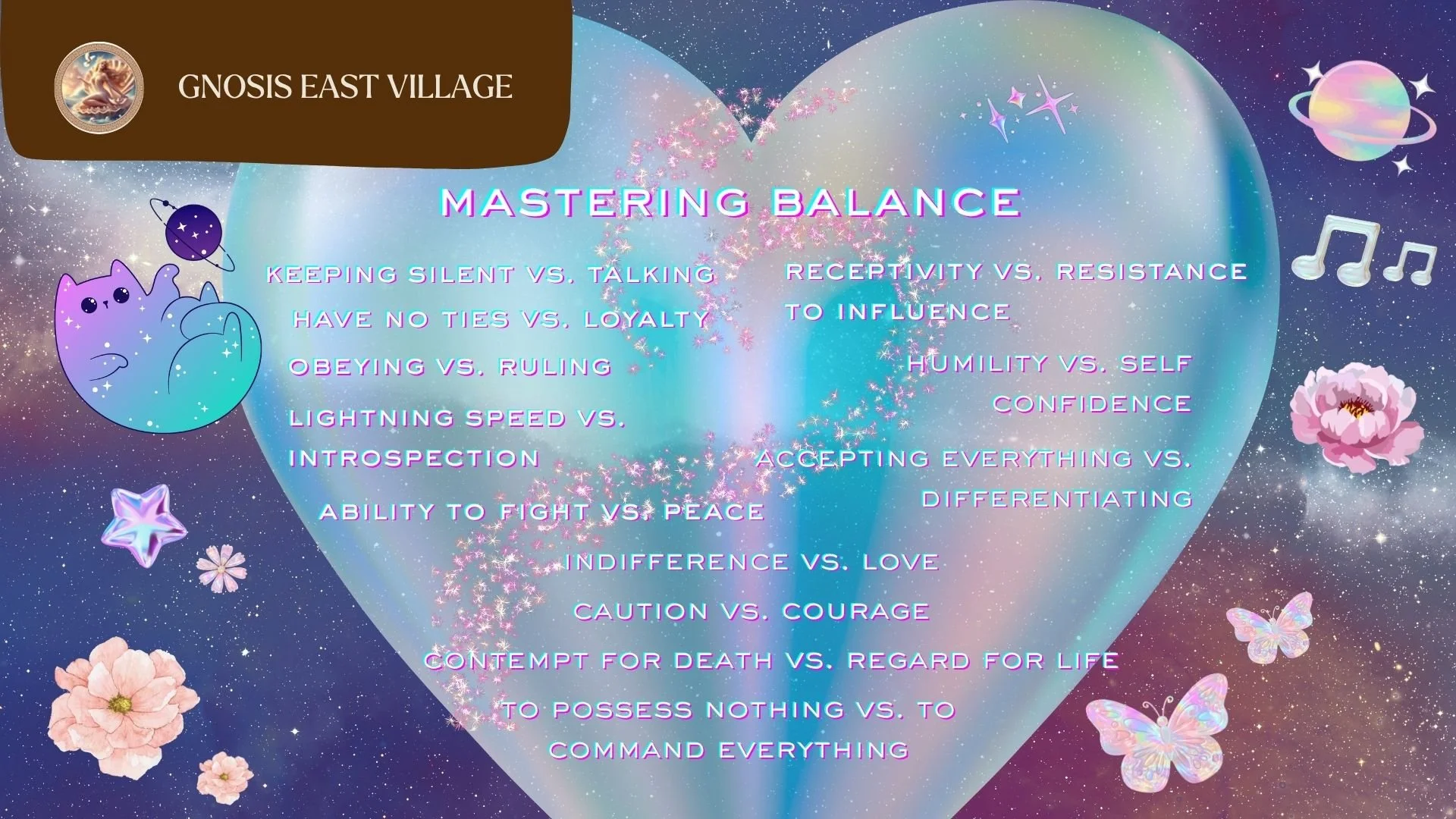
Instructor:
Yes, so we'll just read them out and then we can give some examples. So we have
keeping silent versus talking
having no ties versus loyalty
obeying versus ruling or having internal authority, autonomy
lightning speed versus introspection
ability to fight versus peace
indifference versus love
caution versus courage
contempt for death versus regard for life
to possess nothing versus to command everything
receptivity versus resistance to influence
humility versus self-confidence
accepting everything versus differentiating
Instructor:
And with these things, we want to notice that none of these twofold is not necessarily that one is correct or incorrect. It's not a good or bad thing, but actually, if we utilize these things with consciousness, then that's when we are acting in a divine sense. And if we are unconscious and we utilize these things at the incorrect time, then they could be egoic, satanic or evil or whatever.
Instructor:
Low vibration.
Instructor:
The difference between the only true duality in that sense, the difference between good and evil, which the Unity is beyond that, is just, are we doing things consciously or unconsciously? And if we do things, as we said, out of place, then we can cause harm. And if we do it at the right time, then we can do, then we act in a conscious way and actually handle the situation properly.
Instructor:
And this is not something easy to master, so it's a whole journey that can go over many many many incarnations. But when we come into an initiatic school, then the goal is mastery and mastery is perfect balance, and being able to balance all of these. So, no one can give you a rule of thumb. That's what the ego wants. The ego wants to say, give me some technique, give me some acronym, give me some mind-tool, and then I'll always use this. And then I can be super asleep, right?
Because the awareness in the moment that perceives and can make the best choice, it has to be with the situation of the moment that is always changing. So how could you have a rule of thumb? And what often happens when the ego gets involved is that we know, we intuitively know, we have to balance these poles, but we do the opposite.
So, one example from personal experience is to do with people-pleasing and feeling like, "Okay, I shouldn't people please,” right? So when someone does something, how much I indulge them or their interests is a fine line. You could be kind and friendly and listen for 5 minutes about something that you're not interested in or you could spend 2 hours. Right?
So this is something that I'm working with, just like we all are working with our internal psychology to become more conscious and aware. So knowing that, there was one day when someone said, "Oh, here's this music that I really, really like, and do you want to listen to it?” And I didn't really, I didn't really prefer that kind of music, but I said, “Oh yes, sure. Play this music for me.”
And then as they were playing it, it was very awkward because I didn't know what to say to them. I didn't want to lie and say, “Wow, I love it,” and be inauthentic. But also, I didn't want to hurt their feelings because I was trying to make them happy. So I just randomly made comments like, “ah, this sounds like someone walking in the field or maybe they're milking cows.” And this person got super offended, because they said, you must be mocking my music. Of course, though, my emotions and what I really thought betrayed me, right? And then they got so angry. And I went, “Oh no. The people-pleasing backfired. My chasing of their approval and their happiness led to them getting angry. So the next time I'm going to assert myself, and then person B comes along, and they said, “Oh, I want to show you this really funny clip from this cartoon. You're going to love it and just wait till you see it,” and I said,
“No, I need to set a boundary. If I listen to them, it just means that I'm people-pleasing.” And so, I said, “No, I don't want to watch this cartoon. Stop it. I'm setting a boundary.” And then on reflection, maybe I did want to see that cartoon, but I was confusing when to use which pole. I was pleasing the wrong person at the wrong time or acquiescing at the wrong time, right?

Inauthenticity due to people-pleasing.
When the person was going to bore me with this music that was just so disagreeable to my person, it wasn't the loving and kind thing to do to pretend to like it. It just caused them to get more upset, right? But in the other case, it was something new, this new whatever piece of art that I wasn't familiar with, that it would have been fine to explore. I didn't know if I liked it or not. I just automatically said, “No,” because I thought now is the time to set a boundary.
So we can see from this example that it's not that easy just because you know about this doesn't mean that you're always going to make the conscious choice. You can still be trying to apply this information mechanically or egoically, and then it will backfire. But that's good because then we learn from it. So as long as we're practicing moment-to-moment awareness, and even in contemplation, retrospection, reflecting about our day, then we're going to start to catch these patterns.
Instructor:
That's an example of receptivity versus resistance to influence. But we could do that with all of these things, Keeping silence versus talking, Obviously, if we self-reflect, we don't want to talk as much. And just in the sense of being able to observe ourselves and be in the moment, and also to let others be themselves and go through their own experiences. But at the same time, keeping silent could also be a negative thing.
For example, if there is an echo chamber and there's a lot of people pushing a narrative that will cause harm to others. And no one speaks out against it. Well, if you just keep silent, because, okay, you know, it's not going to affect you. Somebody else who's not as experienced may fall into something that they shouldn't have. So it is almost obligatory, at that sense, to say something.
So, if we could do that with all of these two, loyalty or no ties, you could be loyal to a fault to someone who's causing harm to themselves and to you, and you're not helping them anyway. But to just be completely apathetic to everyone and have no relationships is also a little bit out of balance.
And, obeying and rule versus ruling. You know, you show others respect, but also, you don't want to, just be completely blind, have blind obedience. You don't also want to be a tyrant, but you also want to be able to have leadership skills. So all these things are their proper moments in time.
The lightning speed and the introspection, right? Sometimes we have to act immediately, but other times it's better to reflect and take a step back. We have to know when it's right and when that's intuition, and we also have to learn to reflect.
Instructor:
Because it can be a reaction or it can be consciously, “I need to make a move now. This is important.”
Instructor:
All of these, accepting everything versus differentiating, humility versus self-confidence, humility as the more colloquial sense of it, right?
But there's a time to be reserved, and then there's also a time to believe in yourself. Out of place, you come across as arrogant, or someone who's too meek and inferior.
Caution and courage—all of these things.
Instructor:
We define coherence as being in alignment within our energy field, lining up our mind, our emotions, our will, and our presence, our acceptance of the present moment, because it's only from a place of internal balance and equanimity that we'll be able to process and comprehend the karma and the events that are arriving to us so that we can dissolve our karma or dissolve egos and thereby extracting the wisdom and transcending it, and then moving to manifest a new reality.
We talked about how dissolving ego is very important, but even before we can do that, it's best to just be in alignment in our three brains first and then, of course, start to work on the ego because that relates to our karma.
So a daily retrospection and meditation is a very good practice to have. And of course, moment to moment awareness. Without these 2 fundamental tools, we could get lost in mechanicity and in intellectually applying all these things and missing more subtle, energetic aspects of this equation. So if we do nothing else, those are some good tools to adopt, to take up and to build into our spiritual practice.
And the fundamental summary, we could say, is that when we bring all of this together and we come into perfect balance and harmony, alignment in every way, both internally, externally, and in alignment with the divine, then that will naturally lead to mastery. So rather than saying, “Oh, Ruth and Adonis said, here's the 12 steps to mastery. So I'm just going to download that and keep it as a rule in my head.” That's not going to work.
It's somewhere that we get to by doing the hard work of internally, seeking to balance our emotions, our mind, and our actions and continuously remaining aware and self-reflecting. And then little-by-little. One day we find that we're more masterful over how we are manifesting the reality around us because there is a reason that every single thing happens. And the consciousness when it's awakened can figure out why, and how, and then we can manifest a better reality for ourselves and the collective.
All right. Thank you, everyone.
